DigitalRGS Apple Guide: Revealing Facts You Should Know
Quick Answer
"DigitalRGS Everything Apple" is a search phrase, not an Apple product or official guide. It appears in a site description on digitalrgs.co.uk, but we found no standalone Apple guide on the DigitalRGS domains we checked. This TechSouls guide covers what people searching it want: Apple's devices, iCloud, Continuity features, Apple Intelligence, security, and buying advice.
If you’re new to Apple or considering switching from another platform, this guide explains everything you need to know in one place. You’ll learn how Apple’s products, software, cloud services, and ecosystem work together, what each device is best for, how to choose the right products, and how to get the most value from features like AirDrop, iCloud, Apple Intelligence, Handoff, and Continuity.
Whether you’re buying your first iPhone or building a complete Apple setup, this guide provides the knowledge you need to make informed decisions. And if you’re a business looking to reach Apple users, professional web and app development can help you build iPhone-friendly apps and websites that fit seamlessly into the Apple experience.
Key Insights
- The Apple ecosystem works best when all your devices are signed in with the same Apple Account.
- You don’t need every Apple product. An iPhone paired with a Mac or iPad already unlocks AirDrop, Handoff, Universal Clipboard, and iCloud syncing.
- iCloud is the backbone of the experience, keeping photos, notes, passwords, and backups up to date across devices.
- Apple Intelligence brings AI writing tools, summaries, and a smarter Siri to supported devices. Availability depends on model, language, and region.
- Built-in security tools like Face ID, Find My, two-factor authentication, and iCloud Keychain protect your data without extra apps.
- Apple products cost more upfront, but long software support, strong resale value, and refurbished or education pricing can lower the real cost over time.
What Is DigitalRGS Everything Apple, and Where Does the Name Come From?
Short version: it's a phrase, not a product.
"DigitalRGS Everything Apple" isn't an Apple app, an Apple service, or an official support resource. The clearest source we found is a site description on digitalrgs.co.uk, a multi-topic blog, which says digitalrgs.org covers gaming, tech and "digitalrgs everything Apple."
That's where the trail goes cold. When we checked on October 23, 2026:
- A Google site: search for digitalrgs.org returned no indexed pages.
- The DigitalRGS-named sites we could open, digitalrgs.co.uk and digitalrgs.net, are general blogs with menus for Business, Health, Law, Tech and Travel. Neither has an Apple section.
- Neither homepage says who runs it, or whether the domains are connected.
So this page is TechSouls' own guide, written for people who searched that phrase and want what it promises: one place that explains Apple's devices, software and services, with the facts checked. TechSouls has no connection to DigitalRGS or to Apple Inc. Where we state an Apple fact, we link to Apple's documentation so you can check it.
This guide is written for:
- First-time Apple users who want to understand the basics
- Android or Windows users considering a switch
- Students and professionals planning an Apple setup
- Existing Apple users who want to get more from features they already own
All product names and trademarks belong to their respective owners.
What Is the Apple Ecosystem?
The Apple ecosystem is a connected network of hardware, software, and online services designed to work together seamlessly. Instead of treating each device as a separate product, Apple has built an integrated ecosystem where your iPhone, iPad, Mac, Apple Watch, AirPods, Apple TV, HomePod, and other devices can share information, communicate instantly, and continue tasks across devices. This kind of connectivity also reflects the broader evolution of digital technology, where devices and services have become increasingly interconnected.
For example, you can:
- Start writing an email on your iPhone and finish it on your Mac.
- Copy text on your Mac and paste it on your iPad.
- Take a photo with your iPhone and instantly edit it on your Mac.
- Unlock your Mac automatically while wearing your Apple Watch.
- Locate misplaced devices using the Find My network.
- Receive calls and messages on multiple Apple devices without switching between them.
This seamless integration is one of the defining features of Apple’s ecosystem and shows how modern technology can connect multiple devices into a unified digital experience.
Why Is the Apple Ecosystem So Popular?
Many technology companies manufacture smartphones, laptops, tablets, and smart devices. Apple’s approach is different because it controls both the hardware and the software that power its products. This allows devices to communicate efficiently and deliver a more consistent user experience.
Some of the biggest advantages include:
- Seamless synchronization across devices
- Regular software updates
- Strong privacy protections
- Consistent interface design
- Reliable performance
- Long-term software support
- Integrated cloud services
- Built-in accessibility features
Instead of installing multiple third-party tools to connect devices, most Apple features work automatically once you sign in with the same Apple Account.
Meet Apple’s Product Lineup
Apple offers a wide range of products designed for different needs. Understanding what each device does makes it easier to choose the right combination.
| Product | Primary Purpose | Best For |
| iPhone | Smartphone | Everyday communication, photography, apps |
| iPad | Tablet | Reading, note-taking, education, entertainment |
| MacBook | Portable computer | Students, professionals, creators |
| iMac | Desktop computer | Home offices and creative work |
| Mac mini | Compact desktop | Budget-conscious Mac users |
| Mac Studio | High-performance workstation | Video editors, developers, designers |
| Apple Watch | Smartwatch | Fitness, health, notifications |
| AirPods | Wireless earbuds | Music, calls, spatial audio |
| Apple TV | Streaming device | Home entertainment |
| HomePod | Smart speaker | Music and smart home control |
| Apple Vision Pro | Spatial computing headset | Productivity, immersive media, and mixed reality experiences |
Each product is designed to function independently, but their full value becomes apparent when used together within the Apple ecosystem.
Understanding Apple’s Operating Systems
Each Apple device runs software specifically designed for its hardware. Although every operating system has its own purpose, they share a familiar design language and work together through common features and services.
iOS
iOS powers the iPhone. It focuses on security, ease of use, app performance, communication, and mobile productivity.
Typical uses include:
- Calling and messaging
- Photography
- Mobile payments
- Navigation
- Gaming
- Productivity apps
iPadOS
iPadOS is based on iOS but includes additional features that make multitasking and creative work more efficient on larger screens.
Examples include:
- Split View
- Stage Manager (supported models)
- Apple Pencil support
- External display support
- Enhanced file management
macOS
macOS is Apple’s desktop operating system for Mac computers.
It provides:
- Professional productivity tools
- Development environments
- Creative software support
- File management
- Advanced multitasking
- Desktop-class applications
Many users rely on macOS for software development, video editing, graphic design, and office work.
watchOS
watchOS powers the Apple Watch, focusing on health, fitness, notifications, and quick interactions. It tracks workouts, monitors heart rate, and can provide safety features such as fall detection and emergency SOS on supported models.
tvOS
tvOS runs on Apple TV devices, offering access to streaming services, games, smart home controls, and content from the Apple TV app through a simple interface optimized for televisions.
visionOS
visionOS powers Apple Vision Pro, Apple’s spatial computing platform. It enables users to interact with apps, media, and virtual workspaces using eye tracking, hand gestures, and voice commands, blending digital content with the physical environment.
Apple Account (Formerly Apple ID): The Foundation of the Ecosystem
An Apple Account is the sign-in that connects your Apple devices and services. Apple renamed it from Apple ID in 2024. You still sign in with the same email or phone number and password (Apple Support).
After signing in with the same Apple Account on multiple devices, you can access:
- iCloud storage
- App Store purchases
- Apple Music
- Apple TV (the streaming service, formerly Apple TV+)
- Apple Arcade
- Apple Pay (where available)
- Find My
- Notes
- Photos
- Contacts
- Calendars
- Messages
- Passwords (via iCloud Keychain)
- Device backups
Using a single Apple Account ensures that your personal data remains consistent and accessible, whether you’re using an iPhone, iPad, Mac, or another Apple device.
Why iCloud Matters
iCloud is Apple’s cloud service that securely stores and syncs your data across devices. Rather than manually transferring files, iCloud automatically updates supported content so you always have access to the latest version.
Common examples include:
- Photos taken on your iPhone appearing on your Mac within moments.
- Notes created on your iPad becoming available on your iPhone.
- Safari tabs syncing between devices.
- Automatic backups to help restore data if you replace or reset a device.
- Shared photo libraries and files for family members or collaborators.
For most users, enabling iCloud is one of the first steps toward experiencing the full benefits of the Apple ecosystem.
How Apple Devices Work Together
One of Apple’s biggest strengths is how its devices communicate with each other. Instead of acting as isolated gadgets, they create a connected experience that saves time and reduces repetitive tasks.
This integration is possible because Apple designs its hardware, operating systems, and cloud services to work together under the same Apple Account.
Each feature has its own requirements, such as the same Apple Account, Bluetooth and Wi-Fi on, and supported OS versions. Apple keeps the current list on its Continuity requirements page.
Here’s how some of the most useful ecosystem features work.
AirDrop: Fast Wireless File Sharing
AirDrop lets you send files wirelessly between nearby Apple devices using a combination of Bluetooth and Wi-Fi. You don’t need cables, email attachments, or third-party apps.
You can share:
- Photos
- Videos
- Documents
- Contacts
- Web links
- Maps locations
- Passwords (supported versions)
Example
- A student takes lecture notes on an iPad and quickly sends the PDF to a MacBook before class ends.
- A photographer transfers hundreds of images from an iPhone to a Mac in minutes without connecting a cable.
Best Practices
- Keep Bluetooth and Wi-Fi enabled.
- Use Contacts Only sharing for better privacy.
- Rename devices for easier identification.
Handoff: Continue Your Work Anywhere
Handoff allows you to start a task on one Apple device and continue it on another without losing progress.
Supported activities include:
- Safari browsing
- Notes
- Calendar
- Pages
- Numbers
- Keynote
- Many third-party apps
Example Workflow
- Research a topic on your iPhone.
- Open your MacBook.
- Click the Handoff icon.
- Continue reading exactly where you stopped.
The transition is nearly seamless, making it easier to move between devices during the day.
Universal Clipboard
Universal Clipboard extends copy-and-paste across Apple devices.
Example
- Copy an address on your iPhone.
- Paste it directly into Apple Maps on your Mac.
Or:
- Copy a paragraph on your Mac.
- Paste it into a note on your iPad.
It feels like all your devices share a single clipboard.
Continuity Features
Continuity is a collection of features that make Apple devices behave like parts of one system.
Popular Continuity features include:
Continuity Camera
Use your iPhone as a webcam for your Mac, often delivering better image quality than built-in laptop cameras.
iPhone Cellular Calls
Answer and make phone calls from your Mac or iPad when your iPhone is nearby and signed in with the same Apple Account.
SMS and iMessage Sync
Messages stay synchronized across your Apple devices, so conversations continue wherever you’re working.
Instant Hotspot
Your Mac or iPad can automatically connect to your iPhone’s cellular hotspot without manual setup.
Sidecar
Turn a compatible iPad into a second display for your Mac. This is especially useful for designers, developers, and multitaskers.
Continuity Camera Scanner
Scan a document using your iPhone and insert it directly into a document you’re editing on your Mac.
Find My: Locate Devices and People
Find My combines device tracking, item tracking, and optional location sharing into one service.
You can use it to:
- Find a lost iPhone
- Locate an iPad
- Ring misplaced AirPods
- Track AirTags
- Find your Mac
- Share your location with trusted family members or friends
If a device is lost, you can also:
- Mark it as Lost
- Display a contact message
- Lock it remotely
- Erase its data if necessary
This makes Find My one of Apple’s most valuable security features.
Continuity Workflow Examples
Understanding individual features is useful, but seeing them work together shows the real value of the Apple ecosystem.
Student Workflow
- Research on iPhone
- Take notes on iPad with Apple Pencil
- Finish assignment on MacBook
- Submit through Safari
- Receive notifications on Apple Watch
Content Creator Workflow
- Record video on iPhone
- AirDrop footage to Mac
- Edit using professional software
- Store project in iCloud Drive
- Share previews from iPad
Office Professional Workflow
- Receive calls on Mac
- Attend meetings using Continuity Camera
- Access documents from iCloud
- Use Apple Watch for calendar reminders
- Sign PDFs on iPad
These workflows reduce friction by eliminating unnecessary transfers and repeated sign-ins.
Apple Intelligence Explained
Apple Intelligence is Apple’s personal intelligence system that brings AI-powered capabilities to supported Apple devices while emphasizing privacy.
Unlike many cloud-first AI systems, Apple combines on-device processing with secure cloud computing for tasks that require more computational power.
Depending on the device and supported language, Apple Intelligence can help users:
- Rewrite and summarize text.
- Proofread writing.
- Generate custom images in supported apps.
- Organize notifications.
- Prioritize emails.
- Search photos using natural language.
- Improve Siri interactions.
- Assist with everyday productivity.
Why It Matters
Rather than functioning as a separate app, Apple Intelligence is designed to integrate across the operating system, making AI features available where users already work.
Support varies by device model, operating system version, region, and language, so users should verify compatibility before expecting all features.
Siri and Apple Intelligence
Siri remains Apple’s built-in voice assistant, but newer versions benefit from Apple Intelligence on supported devices.
This improves:
- Context awareness
- Natural conversations
- Writing assistance
- Personal requests
- App interactions
While Siri continues to evolve, feature availability depends on software updates and supported hardware.
Apple Services Explained
Apple’s ecosystem extends beyond hardware through subscription and cloud services that add convenience and additional functionality.
Apple One
Apple One bundles several Apple subscriptions into a single monthly plan.
Depending on the chosen tier, it may include services such as:
- Apple Music
- Apple TV
- Apple Arcade
- iCloud+
- Apple Fitness+
- Apple News+ (availability varies by region)
For users who subscribe to multiple Apple services, a bundle can simplify billing and, in some cases, reduce overall cost.
Apple Music
Apple Music is Apple’s music streaming platform.
Features include:
- Millions of songs
- Curated playlists
- Lossless audio (supported devices)
- Spatial Audio (supported content and hardware)
- Offline listening
- Personalized recommendations
It’s well integrated across iPhone, iPad, Mac, Apple Watch, HomePod, and Apple TV.
Apple TV (Formerly Apple TV+)
Apple TV is Apple's subscription streaming service for original films, documentaries and series. Apple dropped the "+" in October 2025, so older guides still say Apple TV+. Don't confuse it with the Apple TV box in the product table above. The service also works on many non-Apple TVs and streaming devices.
Apple Arcade
Apple Arcade offers a collection of premium games without in-app purchases or advertisements.
Subscribers can play across:
- iPhone
- iPad
- Mac
- Apple TV
Many titles also support game progress synchronization across devices.
Apple Fitness+
Apple Fitness+ provides guided workouts that integrate with Apple Watch to display real-time metrics such as heart rate and calories burned during compatible sessions.
It supports a variety of workout categories, making it suitable for users with different fitness goals.
Apple Pay
Apple Pay enables secure contactless payments using compatible Apple devices where the service is supported.
Benefits include:
- Tokenized transactions
- Face ID or Touch ID authentication
- Online purchases
- In-app payments
- Reduced need to carry physical cards
Availability depends on country, region, and participating financial institutions.
AppleCare+
AppleCare+ extends support beyond the standard warranty by offering additional service options, technical support, and accidental damage coverage (subject to plan terms and service fees).
Coverage varies by product and country, so users should review the specific plan before purchasing.
Which Apple Services Fit Different Users?
| Service | Best For | Recommended? |
| Apple Music | Music lovers | ✅ Yes |
| Apple TV (service) | Original TV and movies | ✅ Yes |
| Apple Arcade | Casual and family gaming | ✅ If you play regularly |
| Apple Fitness+ | Health and fitness | ✅ For Apple Watch users |
| Apple One | Multiple subscriptions | ✅ Often good value |
| Apple Pay | Secure payments | ✅ Where available |
| AppleCare+ | Device protection | ✅ For expensive devices |
The right combination depends on your devices, budget, and how deeply you want to invest in the Apple ecosystem.
Choosing the Right Apple Device
Apple offers products for different budgets and use cases. Rather than buying every device at once, it’s usually better to start with the one that best matches your needs and expand your ecosystem over time.
Quick Decision Matrix
| If You Are... | Recommended Starting Device | Why |
| First-time Apple user | iPhone | The easiest way to experience the Apple ecosystem |
| Student | iPad or MacBook Air | Great for note-taking, assignments, and online learning |
| Office professional | MacBook Air or MacBook Pro | Productivity, multitasking, and long battery life |
| Creative professional | MacBook Pro or Mac Studio | Designed for demanding creative workloads |
| Frequent traveler | iPhone + Apple Watch + AirPods | Portable and highly integrated |
| Family | iPhone + iPad + Apple One | Easy content sharing and Family Sharing features |
Tip: You don’t need every Apple product to benefit from the ecosystem. Even pairing an iPhone with a Mac or iPad unlocks many of its most useful features.
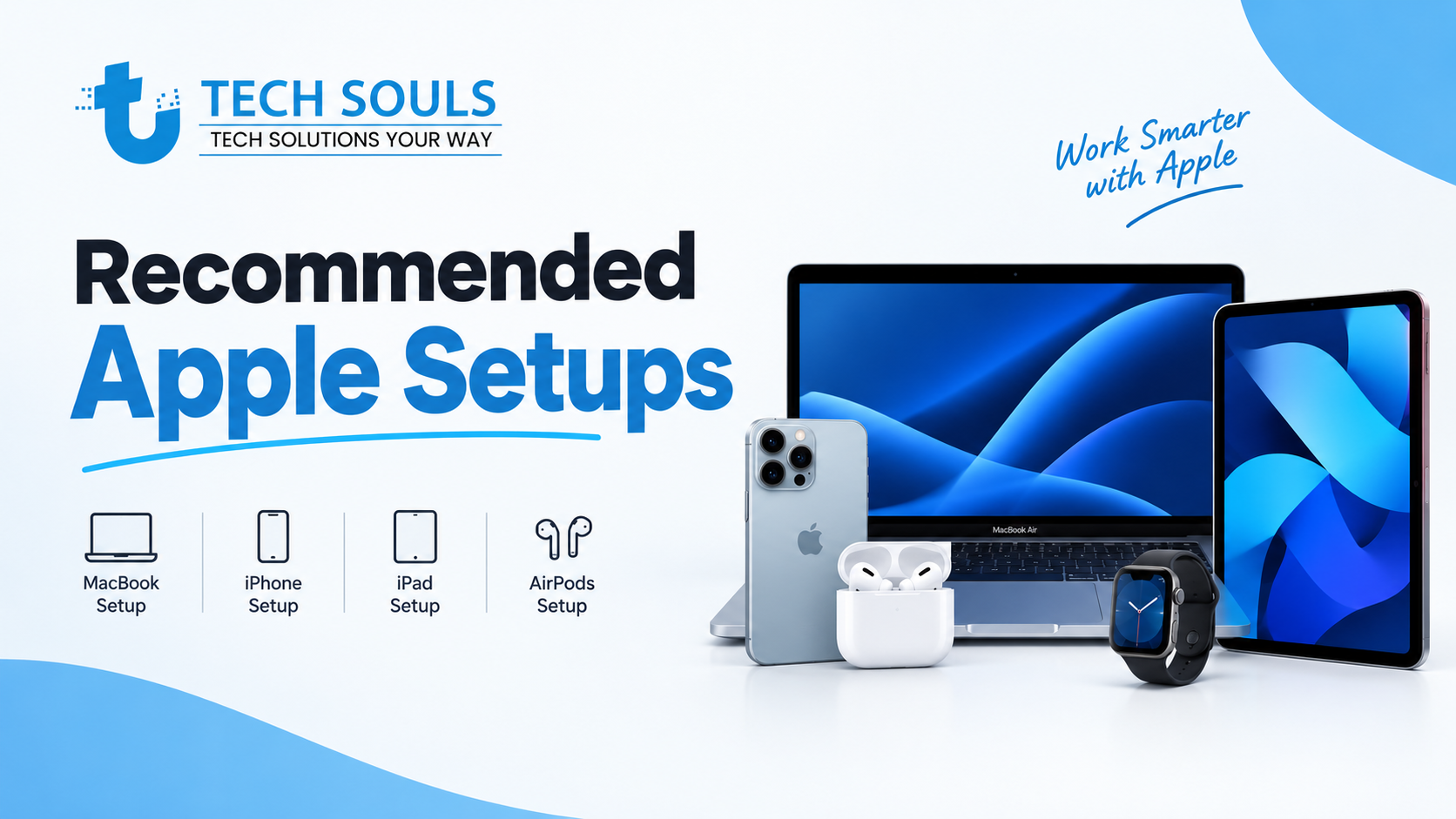
Recommended Apple Setups
For Students
Recommended devices:
- iPhone
- iPad
- Apple Pencil (compatible models)
- MacBook Air
Benefits:
- Digital note-taking
- Cloud-synced study materials
- Easy file sharing with AirDrop
- Long battery life for classes
- Productivity apps across devices
For Professionals
Recommended devices:
- MacBook Pro
- iPhone
- Apple Watch
- AirPods Pro
Benefits:
- Seamless communication
- Calendar and reminder integration
- Video meetings with Continuity Camera
- Secure authentication
- Cross-device productivity
For Creators
Recommended devices:
- MacBook Pro or Mac Studio
- iPad Pro
- Apple Pencil Pro (compatible models)
- iPhone
- AirPods Pro
Benefits:
- Video editing
- Graphic design
- Illustration
- Audio production
- Photography workflows
- Large file synchronization with iCloud Drive
For Families
Apple’s Family Sharing feature allows eligible family members to share purchases, subscriptions, storage, and device location while maintaining separate Apple Accounts.
A typical family setup might include:
- Shared Apple One subscription
- Shared iCloud storage
- Shared photo albums
- Shared calendars
- Shared reminders
- Find My location sharing
- Screen Time controls for children
Step-by-Step Guide to Setting Up Your First Apple Device
If you’re new to Apple, following these steps will help you build a solid foundation for the ecosystem.
Step 1: Create or Sign In With an Apple Account
Your Apple Account is required to access the App Store, iCloud, device backups, and Apple services.
Step 2: Enable Two-Factor Authentication
This adds an extra layer of security by requiring a trusted device or verification code when signing in.
Step 3: Set Up iCloud
Choose what you want to sync, such as:
- Photos
- Contacts
- Notes
- Calendars
- Safari
- Passwords
- Files
Step 4: Turn On Find My
This helps locate your devices if they are lost or stolen.
Step 5: Install Essential Apps
Examples include:
- Calendar
- Notes
- Files
- Microsoft Office (if needed)
- Google Drive (if you use Google services)
- Password manager (if you prefer one outside iCloud Keychain)
Step 6: Customize Privacy Settings
Review permissions for:
- Location
- Camera
- Microphone
- Photos
- Notifications
- Bluetooth
Only grant access when an app genuinely needs it.
Step 7: Enable Automatic Software Updates
Keeping your devices updated helps improve security, stability, and access to new features.
Practical Tips Every Apple User Should Know
Small habits and hidden features can make a big difference in how much value you get from your Apple devices.
Use Focus Modes
Create Focus profiles such as Work, Sleep, or Study to silence unnecessary notifications. Focus settings sync across your iPhone, iPad, and Mac automatically.
Automate Tasks With Shortcuts
The Shortcuts app lets you automate routines, such as turning on Low Power Mode at a certain battery level or sending a “running late” message with one tap.
Copy Text From Images With Live Text
Point your camera at a sign, receipt, or document, or open a photo, to select, copy, translate, or call text directly from the image.
Hide Your Real Email Address
With iCloud+, Hide My Email creates random forwarding addresses for sign-ups, protecting your inbox from spam and data leaks.
Check Battery Health
On iPhone, go to Settings > Battery to view battery health and turn on optimized charging, which helps slow battery aging.
Customize Control Center
Add the controls you use most, such as Flashlight, Screen Recording, or Low Power Mode, for one-swipe access.
Use Spotlight on Mac
Press Command + Space to search files, open apps, run calculations, and convert units without opening another app.
Set Up Family Sharing Early
Sharing subscriptions, iCloud storage, and purchases with up to five family members avoids paying for the same service twice (Apple Support).
Back Up Before Every Major Update
A quick iCloud or computer backup before installing a major software update protects your data if something goes wrong.
Privacy and Security Features
Apple places a strong emphasis on privacy and security. While no system is completely immune to threats, Apple includes several built-in protections that help users safeguard their data. As digital systems continue to evolve, understanding modern cybersecurity threats and protection methods has also become increasingly important for anyone using connected devices and online services.
Face ID
Face ID uses facial recognition to unlock supported devices, authorize purchases, and access secure apps.
Touch ID
Touch ID uses a fingerprint sensor for authentication on supported devices and remains a convenient alternative where available.
Secure Enclave
The Secure Enclave is a dedicated security component that stores sensitive information such as biometric data and cryptographic keys, helping protect them from unauthorized access.
App Tracking Transparency
Apps must request permission before tracking your activity across other companies’ apps and websites. This gives users more control over advertising-related data sharing.
iCloud Keychain
iCloud Keychain securely stores and syncs passwords, passkeys, Wi-Fi credentials, and other login information across your Apple devices.
Lockdown Mode
Lockdown Mode is an optional security feature designed for individuals who may face sophisticated cyber threats. It restricts certain device functions to reduce potential attack surfaces.
Most users won’t need it, but it’s available when enhanced protection is required.
Tips for Keeping Your Apple Devices Secure
- Use a strong device passcode.
- Keep software updated.
- Enable Find My.
- Turn on Two-Factor Authentication.
- Review app permissions regularly.
- Be cautious of phishing emails and fake websites.
- Download apps only from trusted sources such as the App Store whenever possible.
- Back up important data regularly.
Common Apple Ecosystem Problems and Solutions
Problem: AirDrop Isn’t Working
Possible causes:
- Bluetooth disabled
- Wi-Fi disabled
- Devices out of range
- AirDrop visibility settings
Try this:
- Turn Bluetooth and Wi-Fi on.
- Check AirDrop receiving settings.
- Move devices closer together.
- Restart both devices if needed.
Problem: iCloud Isn’t Syncing
Possible causes:
- Poor internet connection
- iCloud storage full
- Sync disabled
- Temporary service issue
Try this:
- Check available iCloud storage.
- Confirm you’re signed in with the same Apple Account.
- Verify sync settings.
- Restart the affected device.
Problem: Mac Doesn’t Recognize iPhone
Try this:
- Unlock the iPhone.
- Trust the connected computer when prompted.
- Update both devices.
- Use a certified cable if connecting by USB.
Problem: Battery Drains Quickly
Possible causes:
- Background app activity
- High screen brightness
- Location services
- Aging battery
- Resource-intensive apps
Try this:
- Enable Low Power Mode when appropriate.
- Reduce screen brightness.
- Close unnecessary background apps.
- Review Battery settings to identify heavy usage.
Pros and Limitations of the Apple Ecosystem
| Advantages | Limitations |
| Seamless device integration | Premium pricing |
| Long-term software support | Some services vary by region |
| Strong privacy features | Limited customization compared with some platforms |
| Consistent user experience | Best experience often requires multiple Apple devices |
| High-quality hardware and software integration | Certain accessories can be expensive |
| Reliable synchronization | Some features depend on internet connectivity |
Understanding both the strengths and trade-offs helps readers decide whether the Apple ecosystem aligns with their needs and budget.
Saving Money on Apple Products
Apple products are premium-priced, but there are several legitimate ways to reduce what you pay.
Buy Apple Certified Refurbished
Apple’s refurbished store sells tested, cleaned, and repackaged devices at a discount. They come with the same one-year limited warranty as new products, and Apple says you can add AppleCare coverage (Apple).
Use Education Pricing
Students, teachers, and staff at eligible institutions can get discounts on Macs and iPads. Seasonal Back to School promotions may also add extras such as gift cards or accessories, depending on the region.
Trade In Your Old Device
Apple Trade In and many carriers give credit for eligible older devices, which can significantly reduce the cost of an upgrade.
Consider the Previous Generation
When new models launch, earlier models often drop in price. For everyday users, the difference in real-world performance is often small.
Choose Storage Wisely
Storage upgrades are expensive. If most of your photos and files live in iCloud, a lower storage tier plus an iCloud+ plan may cost less than the next storage level.
Bundle Subscriptions With Apple One
If you pay for two or more Apple services, an Apple One plan, especially the Family tier, can cost less than separate subscriptions.
Buy From Authorized Sellers
Discounts from authorized retailers and carriers are common. Avoid unofficial or grey-market sellers, as devices may lack warranty coverage or be locked to another region.
Prices, offers, and program availability vary by country, so check Apple’s official website for your region before buying.
Frequently Asked Questions (FAQ)
What is the Apple ecosystem?
The Apple ecosystem is the combination of Apple hardware, software, and services that work together through a shared Apple Account. Features like AirDrop, Handoff, iCloud, Find My, and Continuity let users move seamlessly between devices.
Do I need multiple Apple devices to use the ecosystem?
No. You can start with a single Apple device, such as an iPhone or Mac. However, adding more Apple products unlocks additional features like cross-device syncing, Universal Clipboard, and Continuity.
What is Apple Intelligence?
Apple Intelligence is Apple’s AI system that integrates writing assistance, notification summaries, image generation, improved Siri capabilities, and other productivity features into supported Apple devices. Availability depends on compatible hardware, software versions, language, and region.
Which Apple device should beginners buy first?
For most beginners, an iPhone is the best starting point because it introduces the Apple ecosystem and works seamlessly with future devices like a Mac, iPad, Apple Watch, and AirPods.
Is iCloud required?
No, but enabling iCloud significantly improves the Apple experience by syncing photos, files, contacts, passwords, notes, and backups across devices.
What’s the difference between macOS, iOS, and iPadOS?
- iOS powers the iPhone.
- iPadOS is optimized for iPads with enhanced multitasking features.
- macOS runs on Mac computers and supports desktop-class workflows.
Although they serve different devices, they share many design principles and work together through Apple’s ecosystem.
Does Apple work well with Windows or Android?
Partly. Apple Music, the Apple TV app and iCloud for Windows all work outside Apple's platforms. Handoff, Universal Clipboard and most Continuity features still need Apple devices on both ends. AirDrop is starting to open up: since November 2025, Google's Quick Share on Pixel 10 phones can send files to iPhones, iPads and Macs that have AirDrop set to "Everyone for 10 Minutes" (TechCrunch). Google built that, not Apple, so check Google's current device list.
Is Apple worth it for students?
For many students, Apple devices offer reliable performance, long battery life, and strong integration across hardware and software. The best choice depends on budget, course requirements, and personal preferences.
What is DigitalRGS Everything Apple?
A search phrase, not an Apple product. It appears in a site description on digitalrgs.co.uk that mentions Apple coverage on digitalrgs.org, but in October 2026 we couldn't find a standalone Apple guide on any DigitalRGS domain. This page is TechSouls' independent guide to the topics people expect under that name.
Is Everything Apple DigitalRGS an official Apple resource?
No. Nothing we found links DigitalRGS to Apple, and TechSouls isn't affiliated with either. For warranty claims, account problems or repairs, go to Apple Support at support.apple.com.
How do I protect my Apple Account?
Use a strong, unique password, keep two-factor authentication turned on, and never share verification codes. Review signed-in devices regularly in Settings and remove any you don’t recognize. Consider adding a Recovery Contact or Recovery Key, and be cautious of phishing messages pretending to be from Apple. Apple will never ask for your password or verification code by email or phone.
What is the Apple One subscription bundle?
Apple One combines multiple Apple services, such as Apple Music, Apple TV, Apple Arcade, and iCloud+, into a single monthly payment. Higher tiers add more iCloud storage and services such as Apple Fitness+. The Family plan can be shared with up to five other people.
How long does Apple support devices with updates?
Apple doesn't publish one support period for every product. Its firmest commitment on record is a 2024 statement under the UK's product security law, listing a minimum of five years of security updates from first supply date for the iPhone 15 Pro Max. In practice support runs longer: iOS 27, released in September 2026, still supports the iPhone 11 series from 2019. Before buying an older or refurbished model, check that it runs the current iOS version.
How many active Apple devices exist worldwide?
Apple’s installed base has passed 2.5 billion active devices worldwide, according to the company’s January 2026 earnings announcement, up from 2.35 billion a year earlier. This includes iPhones, iPads, Macs, Apple Watches, AirPods, and other Apple products.
What are the best Apple tips for beginners?
Sign in with one Apple Account on all your devices, turn on iCloud, Find My, and two-factor authentication, and enable automatic updates. After that, explore AirDrop, Handoff, and Focus modes. These few steps unlock most of the ecosystem’s everyday benefits.
Does the Apple ecosystem justify premium pricing?
It depends on how you use your devices. If you value seamless syncing, long software support, strong privacy, and high resale value, the ecosystem often justifies the higher upfront cost over the device’s lifetime. If you only need basic features or prefer heavy customization, a lower-cost platform may be a better fit. Buying refurbished or using education pricing can help close the price gap.
Final Thoughts
The Apple ecosystem is more than a collection of devices—it’s a connected platform designed to simplify everyday tasks through shared software, cloud services, and intelligent integration.
Whether you’re using a single iPhone or a complete setup with a Mac, iPad, Apple Watch, and AirPods, features like AirDrop, Handoff, iCloud, and Find My can make your workflow more efficient and consistent.
If you’re just getting started, begin with the device that best fits your needs. As your requirements grow, you can gradually expand your setup and take advantage of the deeper integration that makes the Apple ecosystem distinctive.