Evolution of Digital Technology: Trends, AI and Innovation (2026)
Quick Answer
The evolution of digital technology refers to the continuous advancement of digital tools, software, networks, and intelligent systems that improve how people live and how organizations operate. From early computers to cloud computing, artificial intelligence (AI), the Internet of Things (IoT), automation, and blockchain, digital technology has transformed communication, business operations, healthcare, education, and nearly every modern industry. As we move through 2026, emerging technologies are making digital solutions smarter, faster, and more connected than ever before.
Featured Snippet
The evolution of digital technology is the ongoing progression of innovations such as artificial intelligence, cloud computing, automation, IoT, blockchain, and big data. These technologies enable businesses to increase efficiency, improve customer experiences, enhance decision-making, and accelerate digital transformation across industries.
What Is the Evolution of Digital Technology?
The evolution of digital technology is the process through which digital systems continuously improve to solve increasingly complex problems. It involves the shift from basic computing devices to intelligent, connected ecosystems powered by artificial intelligence, cloud infrastructure, automation, and real-time data.
Unlike earlier generations of technology that focused mainly on performing isolated tasks, today's digital technologies are designed to communicate, learn, automate processes, and support data-driven decision-making.
This transformation has changed not only how businesses operate but also how individuals work, learn, shop, communicate, and access essential services.
Why Is Digital Technology Evolving So Quickly?
Several factors continue to accelerate digital innovation:
- Growing internet connectivity
- Increasing amounts of data
- Affordable cloud infrastructure
- Rapid advancements in AI
- Demand for automation
- Higher customer expectations
- Global digital competition
- Faster software development cycles
Organizations are no longer investing in technology simply to modernize—they are adopting digital solutions to remain competitive, improve efficiency, and create better customer experiences.
The Evolution of Digital Technology: A Timeline
Understanding where we are today becomes easier when we look at how technology has evolved over the decades.
| Era | Major Innovation | Business Impact |
| 1950s–1970s | Mainframe Computers | Digital record keeping |
| 1980s | Personal Computers | Workplace productivity |
| 1990s | Internet Revolution | Global connectivity |
| 2000s | Mobile Technology | Anytime access to information |
| 2010s | Cloud Computing & Big Data | Scalable digital infrastructure |
| 2020s | Artificial Intelligence & Automation | Intelligent decision-making |
| 2026+ | Generative AI, Edge Computing, Smart Ecosystems | Autonomous digital operations |
Each stage introduced technologies that became the foundation for the next wave of innovation.
From Digitalization to Digital Transformation
Many people confuse digitalization with digital transformation, but they are not the same.
| Digitalization | Digital Transformation |
| Converts paper into digital files | Redesigns entire business processes |
| Focuses on technology | Focuses on business outcomes |
| Limited organizational change | Organization-wide transformation |
| Improves efficiency | Creates new business models |
| Small projects | Long-term strategic initiative |
Digital transformation uses evolving technologies to fundamentally improve how organizations create value.
Core Technologies Driving the Evolution of Digital Technology
Today's digital landscape is shaped by multiple technologies working together rather than operating independently.
1. Artificial Intelligence (AI)
Artificial Intelligence has become one of the most influential technologies of the digital era.
Modern AI systems can:
- Analyze massive datasets
- Generate content
- Predict customer behavior
- Detect fraud
- Recommend products
- Assist customer support
- Improve medical diagnosis
- Optimize logistics
Rather than replacing humans entirely, AI increasingly acts as an intelligent assistant that enhances productivity and decision-making.
Real-World Example
An online retailer uses AI to recommend products based on browsing history, purchase behavior, and customer preferences. This personalized experience often leads to higher customer satisfaction and increased sales.
2. Machine Learning (ML)
Machine Learning is a specialized branch of AI that enables systems to improve their performance by learning from data instead of relying solely on fixed programming.
Machine learning powers:
- Recommendation engines
- Spam filters
- Fraud detection
- Voice assistants
- Search engines
- Predictive maintenance
- Demand forecasting
As businesses collect more data, machine learning becomes increasingly valuable for uncovering patterns and making accurate predictions.
3. Cloud Computing
Cloud computing transformed how organizations access computing resources.
Instead of purchasing expensive physical servers, companies now rent computing power, storage, databases, and software over the internet.
Key Benefits
- Lower infrastructure costs
- Flexible scalability
- Remote collaboration
- Automatic updates
- Faster software deployment
- Disaster recovery
- Improved business continuity
Cloud technology has become the backbone of modern digital transformation.
4. Internet of Things (IoT)
The Internet of Things connects physical devices to the internet so they can collect, exchange, and analyze data.
Examples include:
- Smart homes
- Connected vehicles
- Wearable fitness devices
- Smart factories
- Agricultural sensors
- Energy monitoring systems
- Smart cities
These connected devices provide real-time insights that help organizations improve operational efficiency and make faster decisions.
5. Big Data Analytics
Every second, businesses generate enormous volumes of data from websites, mobile apps, social media, sensors, and customer interactions.
Big Data technologies allow organizations to:
- Understand customer behavior
- Improve marketing campaigns
- Detect operational problems
- Forecast demand
- Identify market trends
- Reduce business risks
Without advanced analytics, much of this valuable information would remain unused.
6. Automation
Automation eliminates repetitive manual tasks by allowing software and intelligent systems to perform them automatically.
Common applications include:
- Invoice processing
- Email marketing
- HR onboarding
- Manufacturing
- Customer support chatbots
- Inventory management
- Workflow approvals
Automation not only saves time but also reduces human error and improves consistency.
7. Blockchain Technology
Although often associated with cryptocurrencies, blockchain has many broader applications.
Businesses use blockchain for:
- Secure transactions
- Supply chain transparency
- Digital identity verification
- Smart contracts
- Healthcare records
- Financial services
Its decentralized architecture improves trust and data integrity across distributed systems.
8. Cybersecurity
As organizations become increasingly digital, protecting sensitive information has become a strategic priority.
Modern cybersecurity includes:
- Multi-factor authentication
- Zero Trust security
- Threat intelligence
- Endpoint protection
- Cloud security
- Identity management
- AI-powered threat detection
Without strong cybersecurity, digital transformation initiatives become significantly more vulnerable to attacks and data breaches.
How These Technologies Work Together
One of the biggest misconceptions is that these technologies operate independently.
In reality, they form an interconnected digital ecosystem.
For example:
- IoT devices collect operational data.
- Cloud platforms store and process that data.
- Big Data analytics organizes the information.
- Machine Learning identifies patterns.
- Artificial Intelligence generates insights.
- Automation executes actions based on those insights.
- Cybersecurity protects every stage of the process.
Together, these technologies create intelligent systems capable of continuous learning and improvement.
Traditional Technology vs Modern Digital Technology
| Traditional Technology | Modern Digital Technology |
| Manual processes | Intelligent automation |
| Local servers | Cloud infrastructure |
| Reactive decisions | Predictive analytics |
| Paper-based workflows | Digital workflows |
| Standalone software | Connected platforms |
| Limited scalability | Elastic cloud scaling |
| Periodic reporting | Real-time dashboards |
| Human-only operations | Human + AI collaboration |
| Static systems | Self-improving systems |
| Department-specific tools | Integrated digital ecosystems |
This shift represents more than technological advancement—it reflects a new way of thinking about business operations, customer engagement, and innovation.
Why Digital Innovation Matters More Than Ever
Organizations that embrace digital innovation are better positioned to adapt to changing markets, improve efficiency, and deliver superior customer experiences.
The evolution of digital technology enables businesses to:
- Respond faster to customer needs
- Reduce operational costs
- Improve collaboration
- Make data-driven decisions
- Launch products more quickly
- Strengthen cybersecurity
- Scale globally with cloud services
- Innovate continuously
Digital transformation is no longer optional for many industries—it has become a key driver of long-term resilience and competitive advantage.
Benefits of the Evolution of Digital Technology
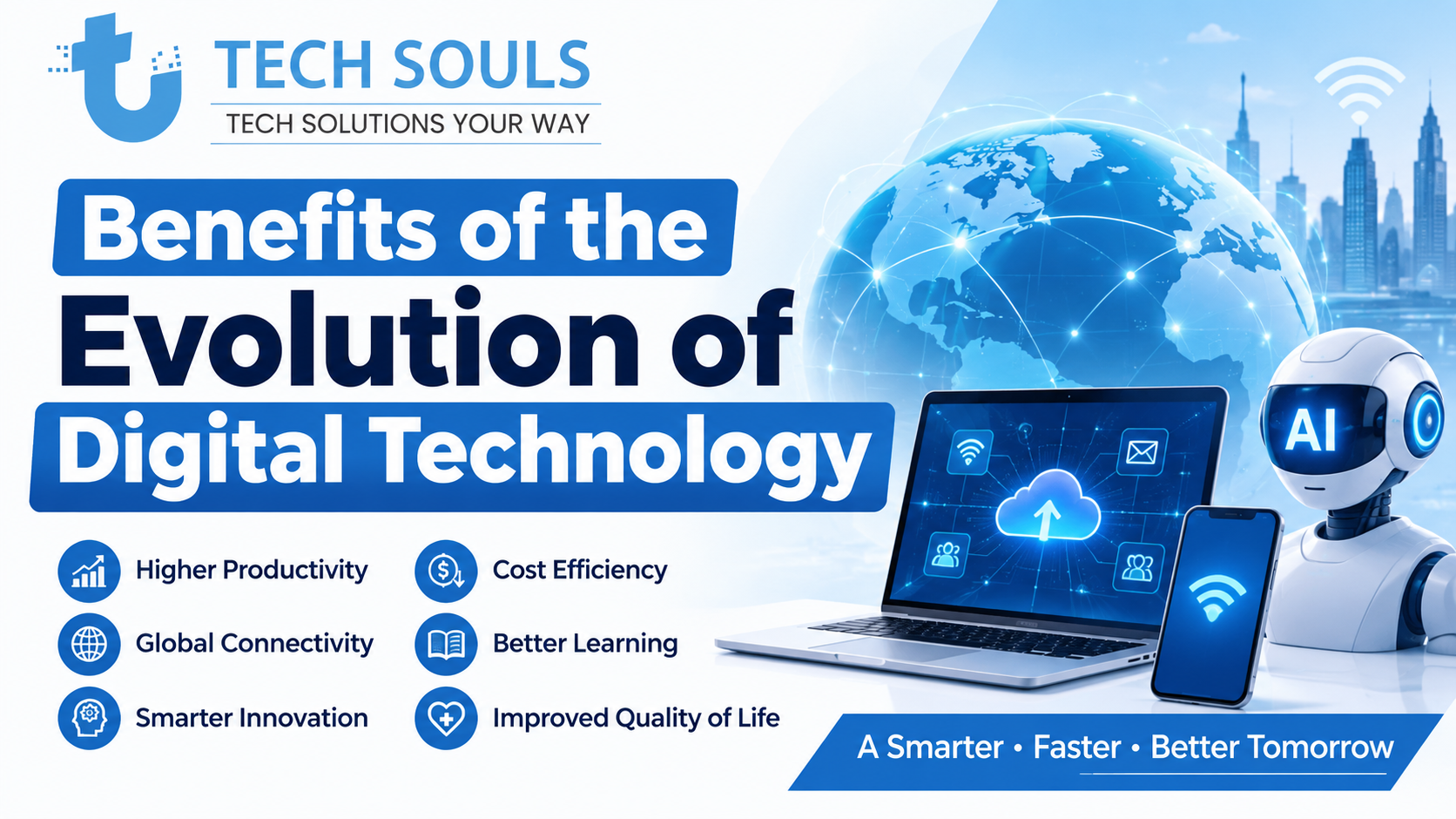
Digital technology has become much more than a productivity tool—it is now a competitive advantage. Organizations that invest in modern digital solutions are often able to innovate faster, make smarter decisions, and adapt more quickly to changing market conditions.
Here are the most significant benefits.
1. Increased Operational Efficiency
One of the biggest advantages of digital transformation is automation.
Instead of spending hours on repetitive tasks, employees can focus on higher-value work.
Examples include:
- Automated invoice processing
- AI-powered customer support
- Inventory management systems
- Payroll automation
- Smart scheduling
- Automated reporting
Example
A retail business that automates inventory tracking can reduce stock shortages, minimize waste, and improve customer satisfaction without increasing staff.
2. Better Decision-Making Through Data
Modern organizations generate enormous amounts of data every day.
Digital technologies help transform this raw data into actionable insights through dashboards, analytics, and AI-powered recommendations.
Businesses can:
- Predict customer demand
- Optimize pricing
- Measure marketing performance
- Detect fraud
- Improve forecasting
- Identify growth opportunities
Professional Tip: Organizations should focus on collecting high-quality, relevant data rather than simply gathering more information.
3. Enhanced Customer Experience
Customers now expect:
- Faster responses
- Personalized recommendations
- Mobile-friendly services
- Secure online transactions
- 24/7 support
Digital solutions make these experiences possible through AI chatbots, recommendation engines, customer relationship management (CRM) systems, and self-service portals.
A better customer experience often leads to stronger loyalty and higher retention.
4. Improved Collaboration
Cloud-based tools allow teams to work together regardless of location.
Benefits include:
- Real-time document editing
- Video conferencing
- Shared project management
- Secure file storage
- Instant communication
This flexibility has become especially valuable for hybrid and remote work environments.
5. Cost Optimization
Although digital transformation requires investment, it can reduce long-term operating costs by:
- Lowering infrastructure expenses through cloud services
- Reducing manual labor
- Minimizing downtime
- Preventing costly errors
- Improving resource allocation
The result is often a stronger return on investment over time.
6. Stronger Cybersecurity
Modern cybersecurity solutions use AI and automation to detect threats, monitor networks, and respond to attacks more quickly than traditional approaches.
Key improvements include:
- Continuous monitoring
- Identity management
- Multi-factor authentication
- Zero Trust architecture
- Automated threat detection
As organizations become more connected, cybersecurity becomes a core part of digital transformation rather than an afterthought.
Industry Applications of Digital Technology
Digital evolution is reshaping nearly every sector. While the technologies are similar, the outcomes differ based on industry needs.
| Industry | Digital Technology Applications |
| Healthcare | AI diagnostics, telemedicine, electronic health records, wearable monitoring |
| Education | Online learning platforms, adaptive learning, virtual classrooms, AI tutors |
| Finance | Digital banking, fraud detection, blockchain payments, robo-advisors |
| Retail | Personalized shopping, inventory automation, recommendation engines |
| Manufacturing | Smart factories, predictive maintenance, industrial IoT, robotics |
| Logistics | Route optimization, warehouse automation, fleet tracking |
| Agriculture | Smart irrigation, crop monitoring, drone technology, IoT sensors |
| Government | Digital services, smart cities, online citizen portals, cybersecurity |
| Marketing | AI content generation, automation, predictive analytics, personalization |
Real-World Digital Transformation Examples
Example 1: Healthcare
Hospitals use AI to analyze medical images and assist doctors in identifying potential diseases earlier.
Benefits include:
- Faster diagnosis
- Improved patient care
- Reduced workload
- Better treatment planning
Example 2: Manufacturing
Factories deploy IoT sensors on production equipment.
Machine learning analyzes equipment performance and predicts failures before they occur.
This reduces:
- Downtime
- Maintenance costs
- Production delays
Example 3: Retail
E-commerce businesses combine AI, cloud computing, and big data to recommend products based on browsing behavior and purchase history.
The result is a more personalized shopping experience that can improve customer satisfaction and increase sales.
Example 4: Banking
Financial institutions use AI-powered fraud detection systems to monitor transactions in real time.
Suspicious activity is identified within seconds, helping reduce financial losses and protect customers.
Challenges of Digital Transformation
While the benefits are substantial, successful digital transformation requires careful planning.
1. Resistance to Change
Employees may hesitate to adopt new systems due to unfamiliarity or concerns about changing workflows.
Solution
- Provide training
- Communicate benefits clearly
- Involve employees early in the process
2. High Initial Investment
Implementing cloud infrastructure, AI platforms, cybersecurity solutions, and automation tools can require significant upfront investment.
Solution
Adopt a phased implementation strategy that prioritizes high-impact projects first.
3. Cybersecurity Risks
As organizations become more connected, the attack surface also expands.
Common threats include:
- Ransomware
- Phishing
- Data breaches
- Insider threats
Solution
Develop a cybersecurity strategy before expanding digital systems.
4. Legacy Systems
Many organizations still rely on outdated software that cannot easily integrate with modern technologies.
Solution
Modernize gradually rather than replacing everything at once.
API integrations and cloud migration strategies often reduce complexity.
5. Skills Gap
Digital transformation requires professionals with expertise in AI, cloud computing, cybersecurity, analytics, and automation.
Many businesses struggle to recruit or train these specialists.
Solution
Invest in continuous learning and upskilling programs.
Digital Transformation Roadmap
Instead of implementing everything simultaneously, organizations should follow a structured roadmap.
| Phase | Objective |
| Assess | Evaluate current technology and business goals |
| Plan | Define priorities and create a transformation strategy |
| Implement | Deploy selected technologies gradually |
| Train | Educate employees and encourage adoption |
| Optimize | Monitor performance and improve continuously |
| Scale | Expand successful initiatives across the organization |
This phased approach reduces risk while increasing the likelihood of long-term success.
Best Practices for Successful Digital Transformation
Start With Business Goals
Technology should solve business problems rather than being adopted simply because it is new.
Always ask:
- What challenge are we solving?
- How will success be measured?
- What value will customers receive?
Focus on the Customer
Successful digital initiatives improve customer experiences rather than simply digitizing internal processes.
Organizations should regularly gather customer feedback and use analytics to understand changing expectations.
Build a Strong Data Foundation
AI and analytics depend on reliable, accurate data.
Poor-quality data often leads to poor business decisions.
Invest in:
- Data governance
- Data quality
- Data security
- Data integration
Prioritize Cybersecurity
Cybersecurity should be integrated into every stage of digital transformation rather than added later.
Security by design is more effective and less costly than fixing vulnerabilities after deployment.
Encourage Continuous Learning
Technology evolves quickly.
Organizations that promote continuous learning are better equipped to adapt to future innovations.
Training should include:
- AI literacy
- Cloud technologies
- Cybersecurity awareness
- Data analytics
- Automation tools
Common Mistakes to Avoid
Many digital transformation projects fail because organizations repeat the same mistakes.
Avoid these common pitfalls:
- Buying technology without a clear strategy
- Ignoring employee training
- Underestimating cybersecurity
- Expecting immediate results
- Failing to measure ROI
- Poor data quality
- Attempting to transform everything at once
- Choosing tools that do not integrate well
- Neglecting customer experience
- Treating transformation as a one-time project instead of an ongoing process
Pro Tips From Technology Experts
1: Start with one high-impact project before scaling across the organization.
2: Measure business outcomes, not just technology adoption.
3: Keep customers at the center of every digital initiative.
4: Invest in employee skills alongside new technology.
5: Review your digital strategy annually to stay aligned with emerging technology trends.
Key Takeaway So Far
The evolution of digital technology is not just about adopting AI, cloud computing, or automation. It is about creating a connected, secure, and data-driven ecosystem that helps organizations innovate, improve customer experiences, and remain competitive in an increasingly digital world.
Future of Digital Technology (2026–2030)
The next phase of digital evolution won't be driven by a single breakthrough. Instead, it will come from the convergence of AI, cloud computing, robotics, IoT, edge computing, and cybersecurity into intelligent, interconnected ecosystems.
Below are the trends most likely to shape the next five years.
1. Generative AI Will Become a Standard Business Tool
Generative AI is moving beyond content creation. Organizations are integrating it into customer service, software development, research, marketing, finance, and operations.
Expected impact:
- AI-powered business assistants
- Faster software development
- Smarter search experiences
- Personalized customer interactions
- Automated report generation
- AI-supported decision-making
Rather than replacing professionals, AI will increasingly augment their work by handling repetitive and data-intensive tasks.
2. Edge Computing Will Accelerate Real-Time Processing
As connected devices continue to grow, processing all data in centralized cloud servers becomes less efficient.
Edge computing solves this by processing information closer to where it is generated.
Common use cases include:
- Autonomous vehicles
- Smart factories
- Healthcare monitoring devices
- Industrial IoT
- Smart cities
The result is lower latency, faster responses, and reduced bandwidth usage.
3. Hyperautomation Will Transform Business Operations
Hyperautomation combines:
- Artificial Intelligence
- Machine Learning
- Robotic Process Automation (RPA)
- Process Mining
- Intelligent Workflows
Instead of automating isolated tasks, organizations will automate complete business processes.
Examples include:
- End-to-end invoice processing
- Employee onboarding
- Supply chain management
- Insurance claim processing
- Customer support workflows
4. Digital Twins Will Improve Decision-Making
A digital twin is a virtual representation of a physical object, process, or system.
Businesses use digital twins to simulate scenarios before making real-world changes.
Industries adopting digital twins include:
- Manufacturing
- Construction
- Healthcare
- Aviation
- Energy
This approach reduces operational risks while improving efficiency and planning.
5. Cybersecurity Will Become AI-Powered
As cyber threats become more sophisticated, organizations will increasingly rely on AI-driven security systems to detect unusual behavior, identify vulnerabilities, and respond to attacks in real time.
Future cybersecurity strategies will emphasize:
- Zero Trust Architecture
- Identity-first security
- Behavioral analytics
- Continuous monitoring
- Automated incident response
Security will no longer be treated as a separate function—it will be integrated into every stage of digital transformation.
6. Responsible AI and Governance
As AI adoption increases, organizations must address concerns around transparency, fairness, privacy, and accountability.
Key priorities include:
- Ethical AI development
- Bias detection
- Human oversight
- Regulatory compliance
- Explainable AI
- Data privacy
Responsible governance will become a competitive advantage, especially in regulated industries.
Comparison: Traditional Business vs Digitally Mature Business
| Area | Traditional Business | Digitally Mature Business |
| Decision-making | Based on experience | Based on real-time data and AI insights |
| Customer support | Business hours only | 24/7 omnichannel support |
| Infrastructure | On-premises servers | Cloud-native platforms |
| Processes | Manual and paper-based | Automated digital workflows |
| Collaboration | Local teams | Hybrid and global collaboration |
| Innovation | Slow product cycles | Continuous improvement |
| Analytics | Historical reports | Predictive and prescriptive analytics |
| Security | Reactive | Proactive and AI-driven |
Emerging Technologies to Watch
While AI dominates headlines, several other technologies are quietly reshaping the digital landscape.
| Technology | Why It Matters |
| Quantum Computing | Solves complex computational problems beyond classical computers. |
| 6G Networks | Enables faster communication and supports advanced IoT applications. |
| Extended Reality (XR) | Combines AR, VR, and MR for immersive learning, training, and collaboration. |
| Green Computing | Focuses on reducing environmental impact through energy-efficient technologies. |
| Privacy-Enhancing Technologies (PETs) | Protect sensitive data while enabling secure analytics and collaboration. |
Businesses should evaluate these technologies based on real-world value rather than hype.
Expert Insights
Successful digital transformation is rarely about buying the latest software. It is about aligning technology with business objectives, people, and processes.
Organizations that consistently succeed tend to:
- Define measurable goals.
- Invest in employee training.
- Modernize gradually.
- Prioritize cybersecurity.
- Measure outcomes continuously.
- Build a culture of innovation.
Technology alone does not create transformation—people and strategy do.
Frequently Asked Questions (FAQs)
What is the evolution of digital technology?
It is the continuous advancement of digital tools, systems, and platforms that improve how people communicate, work, learn, and solve problems. It includes technologies such as AI, cloud computing, IoT, automation, and big data.
Why is digital transformation important?
Digital transformation helps organizations improve efficiency, reduce costs, enhance customer experiences, make data-driven decisions, and remain competitive in rapidly changing markets.
How does AI contribute to digital evolution?
AI analyzes data, automates repetitive tasks, supports decision-making, improves customer interactions, and enables intelligent business processes.
Which industries benefit most from digital technology?
Nearly every industry benefits, including healthcare, education, finance, manufacturing, retail, logistics, agriculture, and government services.
What are the biggest challenges of digital transformation?
Common challenges include resistance to change, cybersecurity risks, legacy systems, budget constraints, poor data quality, and skills shortages.
Is cloud computing essential for digital transformation?
Not every organization must adopt a public cloud, but scalable cloud services often simplify collaboration, data storage, software deployment, and business continuity.
What is Industry 4.0?
Industry 4.0 refers to the integration of smart manufacturing technologies such as IoT, AI, robotics, automation, cloud computing, and real-time analytics.
What is the future of digital technology?
Future developments are expected to focus on generative AI, edge computing, intelligent automation, digital twins, stronger cybersecurity, and responsible AI governance.
Can small businesses benefit from digital transformation?
Yes. Even modest investments in cloud software, automation, AI-powered customer support, and analytics can improve productivity and customer satisfaction.
How should organizations begin digital transformation?
Start by identifying business challenges, setting measurable objectives, assessing current systems, prioritizing high-impact initiatives, and implementing technology in manageable phases.
Key Takeaways
- Digital technology continues to evolve through AI, cloud computing, automation, IoT, blockchain, and analytics.
- Digital transformation is a strategic business initiative, not just a technology upgrade.
- Organizations should align technology investments with business goals.
- Cybersecurity, employee training, and data quality are critical for success.
- Emerging technologies such as edge computing, digital twins, and responsible AI will shape the next phase of innovation.
Conclusion
The evolution of digital technology is transforming how businesses operate and how people interact with the world around them. What began with basic computing has grown into an interconnected ecosystem of intelligent technologies capable of automating processes, analyzing massive datasets, and delivering highly personalized experiences.
For organizations, the real opportunity is not simply adopting the latest technology but using it to solve meaningful business problems, improve customer outcomes, and build long-term resilience.
Companies that embrace continuous learning, invest in secure digital infrastructure, and adopt emerging technologies thoughtfully will be better prepared for the opportunities and challenges of the years ahead.
Digital evolution is an ongoing journey—and organizations that adapt strategically are more likely to lead it rather than follow it.
Continue Exploring TechSouls
Technology is constantly evolving, and staying informed helps you make better decisions whether you're interested in software, AI, cybersecurity, gadgets, or the latest tech trends. At TechSouls, we regularly publish in-depth guides, tutorials, troubleshooting articles, and breaking technology news to keep you updated with accurate and practical information. If you found this article helpful, explore more of our latest content below to expand your knowledge and stay ahead in the fast-changing world of technology.
[Pboxcomputers Tech Updates: AI Trends & Releases (2026)]
[Software Technolotal: Complete Guide (2026)]
[Zenvekeypo4 Software Problem: 15 Easy Fixes for Crashes]
[PlayBattleSquare Guide: Tips, Strategies & Win to Faster (2026)]
[Connectivity HSS Gamepad Complete Guide: Setup & Pairing]
[DigitalRGS Everything Apple Guide: Apple Ecosystem Explained]
[Tommy Jacobs Gaming EyeXcon Guide: Features, Setup]
[Latest Tech Info at BeaconSoft | AI, Cloud & Software Trends 2026]