Aggr8Tech Digital Technology: Features, Benefits & Uses (2026)
Quick Answer
Aggr8Tech Digital Technology refers to a modern digital technology approach that combines artificial intelligence (AI), automation, cloud computing, and data-driven systems to help businesses improve efficiency, streamline workflows, and accelerate digital transformation. Instead of relying on separate tools, it connects multiple technologies into a unified digital ecosystem that supports smarter decision-making and scalable growth.
What Is Aggr8Tech Digital Technology?
Aggr8Tech Digital Technology is a technology-driven approach that integrates AI, automation, cloud computing, and analytics to improve business operations and digital infrastructure. It helps organizations automate repetitive tasks, analyze data more effectively, enhance productivity, and adapt to changing technology trends through scalable digital solutions.
Introduction
Digital transformation is no longer optional for organizations that want to stay competitive. Businesses today rely on automation, artificial intelligence, cloud platforms, and data analytics to improve customer experiences, reduce costs, and make faster decisions.
One concept gaining attention is Aggr8Tech Digital Technology. While the name may sound unfamiliar to many users, it generally represents the integration of modern digital technologies into business processes to create smarter, faster, and more connected operations.
Rather than focusing on a single technology, Aggr8Tech emphasizes bringing together multiple digital solutions—including AI, machine learning, cloud computing, automation, and intelligent analytics—to solve real business challenges.
In this guide, you'll learn what Aggr8Tech Digital Technology is, how it works, its key features, benefits, practical use cases, limitations, and why it could play an important role in the future of digital innovation.
What Is Aggr8Tech Digital Technology?
Aggr8Tech Digital Technology is best understood as a digital innovation framework that combines several advanced technologies into a single connected ecosystem.
Instead of using isolated software for different business tasks, organizations integrate intelligent technologies that can communicate with one another, automate repetitive processes, and provide real-time insights.
The core idea is simple:
Connect technology, automate processes, and use data to make smarter business decisions.
Although implementations may vary between organizations, the underlying objective remains the same—creating a more efficient, scalable, and intelligent digital environment.
Simple Definition
Think of Aggr8Tech like the central nervous system of a modern business.
Instead of having:
- one software for customers,
- another for accounting,
- another for inventory,
- another for reporting,
Aggr8Tech brings these systems together so they work as one connected platform.
This reduces manual work, improves accuracy, and allows businesses to respond faster to changing market conditions.
Aggr8Tech vs Traditional Digital Systems
| Feature | Traditional Systems | Aggr8Tech Digital Technology |
| AI Capabilities | Limited | Advanced AI integration |
| Automation | Mostly manual | Intelligent automation |
| Analytics | Historical reports | Real-time insights |
| Software Integration | Basic | Highly connected ecosystem |
| Scalability | Moderate | Flexible and scalable |
| Decision Making | Reactive | Proactive and data-driven |
| Customer Experience | Standard | Personalized and intelligent |
| Innovation Speed | Slow | Continuous improvement |
Why Is Aggr8Tech Becoming Important?
Businesses generate enormous amounts of data every day.
Without intelligent systems, that data often becomes difficult to manage.
Aggr8Tech helps organizations:
- automate repetitive work,
- connect business applications,
- reduce operational costs,
- improve employee productivity,
- deliver better customer experiences,
- make faster business decisions.
As companies continue adopting AI and cloud computing, integrated technology ecosystems are becoming increasingly valuable.
How Does Aggr8Tech Digital Technology Work?
Aggr8Tech works by connecting different digital technologies into a unified operational environment.
Instead of replacing existing systems, it acts as a layer that enables them to communicate more efficiently.
A typical workflow looks like this:
- Business systems collect data.
- Cloud infrastructure stores the information securely.
- AI analyzes patterns.
- Automation performs repetitive tasks.
- Dashboards display actionable insights.
- Decision-makers use real-time information to improve operations.
This continuous cycle creates a smarter, data-driven organization.
Example Workflow
Imagine an online retail company.
Without integration:
- Orders are processed manually.
- Inventory updates slowly.
- Customer support responds after problems occur.
- Reports are generated weekly.
With an Aggr8Tech-style approach:
- Orders update inventory automatically.
- AI predicts stock shortages.
- Customer service receives instant alerts.
- Managers view live sales dashboards.
- Marketing campaigns adjust based on customer behavior.
The result is faster operations with fewer manual errors.
Core Technologies Behind Aggr8Tech
Aggr8Tech combines several modern technologies rather than relying on one solution.
Artificial Intelligence (AI)
Artificial intelligence helps computers analyze information, recognize patterns, and assist with decision-making.
Examples include:
- intelligent recommendations,
- customer support chatbots,
- fraud detection,
- predictive analytics,
- smart reporting.
Rather than replacing people, AI often enhances productivity by handling repetitive analytical tasks.
Machine Learning
Machine learning enables systems to improve over time by learning from historical data.
Common applications include:
- demand forecasting,
- sales prediction,
- customer segmentation,
- recommendation engines,
- maintenance prediction.
As more data becomes available, machine learning models generally become more accurate.
Cloud Computing
Cloud technology allows organizations to access software and data securely from virtually anywhere.
Benefits include:
- lower infrastructure costs,
- easier collaboration,
- automatic updates,
- flexible scalability,
- improved disaster recovery.
Cloud-first architectures also make it easier to integrate multiple business applications into a single ecosystem.
Automation Tools
Automation reduces the need for repetitive manual work.
Examples include:
- invoice processing,
- employee onboarding,
- workflow approvals,
- document generation,
- customer notifications,
- inventory synchronization.
Automating routine tasks allows employees to focus on higher-value work such as strategy, innovation, and customer relationships.
Data Analytics
Modern businesses collect data from websites, mobile apps, CRM systems, sales platforms, and customer interactions.
Aggr8Tech-style analytics helps organizations transform that raw data into meaningful insights.
Businesses can identify:
- customer behavior,
- purchasing trends,
- operational bottlenecks,
- marketing performance,
- financial risks,
- growth opportunities.
Instead of relying on assumptions, decisions become evidence-based.
Internet of Things (IoT)
Connected devices can continuously share information with business systems.
Examples include:
- smart manufacturing equipment,
- warehouse sensors,
- logistics tracking,
- connected medical devices,
- smart energy systems.
IoT integration enables organizations to monitor operations in real time and respond quickly when issues arise.
Key Characteristics of Aggr8Tech Digital Technology
Most modern digital technology ecosystems share several important characteristics.
Intelligent Automation
Routine tasks are completed automatically with minimal human intervention.
Data-Driven Decision Making
Business leaders receive real-time insights rather than waiting for manual reports.
Scalability
Organizations can expand their digital infrastructure without rebuilding entire systems.
Integration
Multiple software platforms work together instead of operating independently.
Security
Modern implementations often include identity management, encryption, access controls, and continuous monitoring to help protect sensitive business data.
Flexibility
Businesses can adopt only the technologies they need today while remaining prepared for future innovation.
Real-World Example
Consider a healthcare provider managing thousands of patient appointments every week.
Using an integrated digital technology approach, the organization could:
- automatically schedule appointments,
- send reminders,
- analyze patient demand,
- optimize staffing,
- detect unusual trends,
- generate management reports,
- improve patient experiences through AI-powered support.
Instead of managing each task separately, the entire workflow becomes connected and significantly more efficient.
Expert Tip
Successful digital transformation isn't about adopting the newest technology—it’s about choosing technologies that solve real business problems. Organizations that focus on clear objectives, employee training, and gradual implementation typically achieve better long-term results than those pursuing technology for its own sake.
Key Features of Aggr8Tech Digital Technology
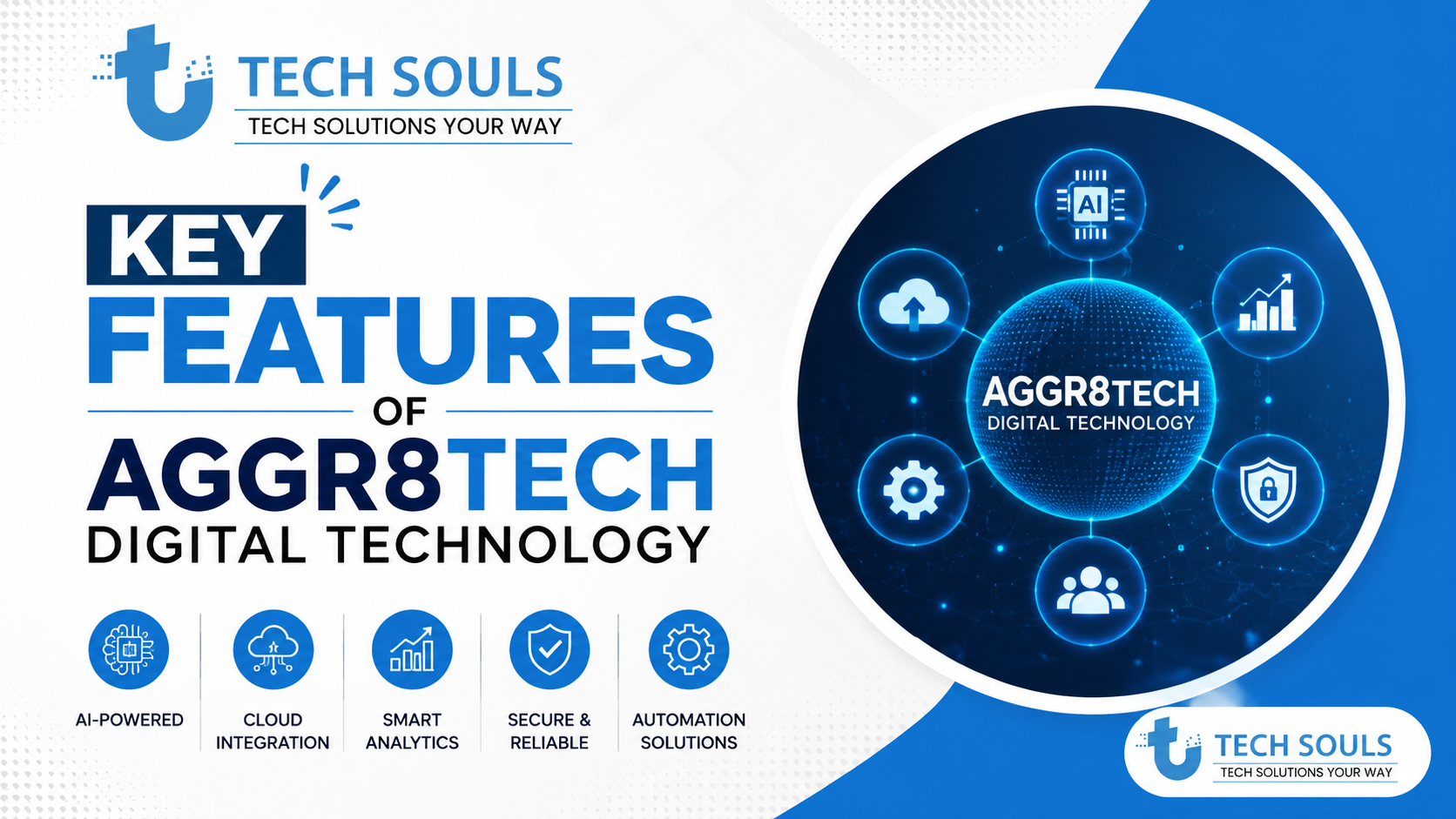
The strength of Aggr8Tech Digital Technology lies in combining multiple technologies into one connected ecosystem. Instead of managing separate tools for different tasks, businesses can integrate their systems to improve efficiency, reduce manual work, and make faster decisions.
Below are the core features that make this approach valuable.
1. AI-Powered Automation
Artificial intelligence is one of the biggest drivers behind modern digital transformation.
Instead of employees spending hours on repetitive tasks, AI can automate processes such as:
- Customer support chatbots
- Email classification
- Invoice processing
- Lead scoring
- Predictive maintenance
- Document analysis
- Workflow approvals
This reduces human error while allowing teams to focus on higher-value work.
Example: An eCommerce company can automatically respond to common customer questions, recommend products, and process refund requests without requiring manual intervention.
2. Smart Data Analytics
Modern businesses generate massive amounts of data every day.
Aggr8Tech Digital Technology helps transform that data into meaningful insights by collecting information from multiple sources, including:
- CRM software
- Websites
- Mobile apps
- Sales platforms
- Marketing campaigns
- Customer interactions
- IoT devices
Instead of manually reviewing spreadsheets, managers receive interactive dashboards with real-time metrics that support quicker and more informed decision-making.
3. Cloud-Based Infrastructure
Cloud computing provides the flexibility to access systems from virtually anywhere while reducing dependence on expensive on-premises hardware.
Benefits include:
- Automatic backups
- Easy collaboration
- Better scalability
- Remote access
- Reduced maintenance costs
- Faster software updates
- Improved disaster recovery
Cloud-based systems also simplify the integration of new applications as business needs evolve.
4. Workflow Automation
Many organizations lose time because employees repeatedly perform the same administrative tasks.
Workflow automation helps eliminate these bottlenecks.
Examples include:
- Employee onboarding
- Purchase approvals
- Inventory updates
- Payroll processing
- Order fulfillment
- Customer notifications
Automated workflows improve consistency while reducing delays and operational costs.
5. Scalable Architecture
Business requirements change over time.
An effective digital technology framework should grow alongside the organization without requiring a complete rebuild.
Scalable solutions allow businesses to:
- Add new users
- Expand storage
- Integrate additional software
- Support larger customer bases
- Handle increased workloads
This flexibility makes future expansion more manageable.
6. Strong Security Controls
As organizations become more digital, protecting sensitive information becomes increasingly important.
Common security capabilities include:
- Data encryption
- Multi-factor authentication (MFA)
- Role-based access control
- Continuous monitoring
- Secure cloud storage
- Regular security updates
- Threat detection
Security should be considered throughout implementation rather than added later.
7. Seamless System Integration
Many businesses already use tools such as CRM platforms, accounting software, HR systems, and marketing applications.
Instead of replacing these systems, Aggr8Tech-style solutions focus on connecting them.
Examples of integrations include:
- CRM ↔ Sales software
- ERP ↔ Inventory management
- Accounting ↔ Payment systems
- Marketing ↔ Analytics platforms
- Customer support ↔ AI chatbots
This creates a connected digital ecosystem where information flows automatically between departments.
Benefits of Aggr8Tech Digital Technology
Organizations adopting integrated digital technologies often experience measurable improvements in productivity, efficiency, and customer satisfaction.
Improved Productivity
Automation reduces repetitive work, allowing employees to spend more time on strategic tasks.
Teams can focus on innovation instead of routine administrative processes.
Better Decision-Making
Real-time analytics provide business leaders with accurate, up-to-date information.
Instead of relying on outdated reports, organizations can quickly identify trends, monitor performance, and respond to changing conditions.
Lower Operational Costs
Automation helps reduce expenses by minimizing manual work and improving resource utilization.
Potential savings come from:
- Fewer repetitive tasks
- Reduced processing time
- Lower error rates
- Improved inventory management
- Better workforce allocation
Enhanced Customer Experience
Customers increasingly expect fast, personalized service.
Integrated digital technologies enable organizations to:
- Respond more quickly
- Personalize recommendations
- Resolve issues faster
- Improve communication
- Offer consistent experiences across multiple channels
Happy customers are more likely to remain loyal and recommend the business to others.
Greater Business Agility
Market conditions can change rapidly.
Businesses using connected digital systems are generally better equipped to:
- Launch new products
- Scale operations
- Respond to customer demand
- Adapt to technological changes
- Improve internal collaboration
Improved Collaboration
When departments share the same data and tools, communication becomes more efficient.
Instead of working in isolated systems, employees can collaborate using shared dashboards, centralized documents, and integrated workflows.
Industry Use Cases
Aggr8Tech Digital Technology can support organizations across many industries.
Healthcare
Healthcare providers can use intelligent digital systems to:
- Schedule appointments
- Manage electronic health records
- Monitor patients remotely
- Automate billing
- Improve diagnostic support through AI
- Reduce administrative workload
Retail & eCommerce
Retail businesses can:
- Predict inventory demand
- Personalize product recommendations
- Automate order processing
- Optimize pricing
- Improve customer support
- Track sales performance in real time
Manufacturing
Manufacturers benefit through:
- Predictive equipment maintenance
- Supply chain visibility
- Automated quality control
- Production planning
- Warehouse automation
- Smart factory monitoring using IoT
Financial Services
Banks and financial institutions can improve operations by:
- Detecting fraud
- Automating compliance checks
- Accelerating loan approvals
- Managing financial risks
- Enhancing customer support through AI assistants
Education
Educational institutions can:
- Personalize learning experiences
- Automate student enrollment
- Track academic performance
- Support online learning
- Improve communication with students and parents
Logistics & Supply Chain
Integrated technology enables logistics companies to:
- Track shipments in real time
- Optimize delivery routes
- Forecast demand
- Reduce transportation costs
- Improve warehouse management
Aggr8Tech Digital Technology vs Traditional Digital Solutions
| Feature | Traditional Systems | Aggr8Tech Digital Technology |
| AI Capabilities | Limited | Advanced AI integration |
| Automation | Mostly manual | Intelligent automation |
| Analytics | Historical reports | Real-time insights |
| Software Integration | Basic | Highly connected ecosystem |
| Scalability | Moderate | Flexible and scalable |
| Decision Making | Reactive | Proactive and data-driven |
| Customer Experience | Standard | Personalized and intelligent |
| Innovation Speed | Slow | Continuous improvement |
Key takeaway: Traditional systems often operate independently, while Aggr8Tech focuses on connecting technologies to create a unified, intelligent environment.
Pros and Cons
| Pros | Cons |
| Improves operational efficiency | Initial implementation costs can be high |
| Supports business growth | May require employee training |
| Reduces repetitive work | Integration with legacy systems can be challenging |
| Enhances decision-making | Data privacy must be carefully managed |
| Enables real-time analytics | Success depends on implementation quality |
| Increases scalability | Ongoing maintenance is required |
Common Mistakes to Avoid
Organizations often face challenges not because of the technology itself, but because of how it is implemented.
Avoid these common mistakes:
- Adopting technology without clear business goals.
- Ignoring employee training and change management.
- Trying to automate every process at once.
- Overlooking cybersecurity requirements.
- Failing to monitor performance after implementation.
- Choosing tools that don't integrate with existing systems.
- Making decisions based only on cost instead of long-term value.
Pro Tip
Start with one high-impact business process—such as customer support, inventory management, or reporting—measure the results, and then expand gradually. A phased implementation usually delivers better outcomes than trying to transform every department simultaneously.
Challenges and Limitations of Aggr8Tech Digital Technology
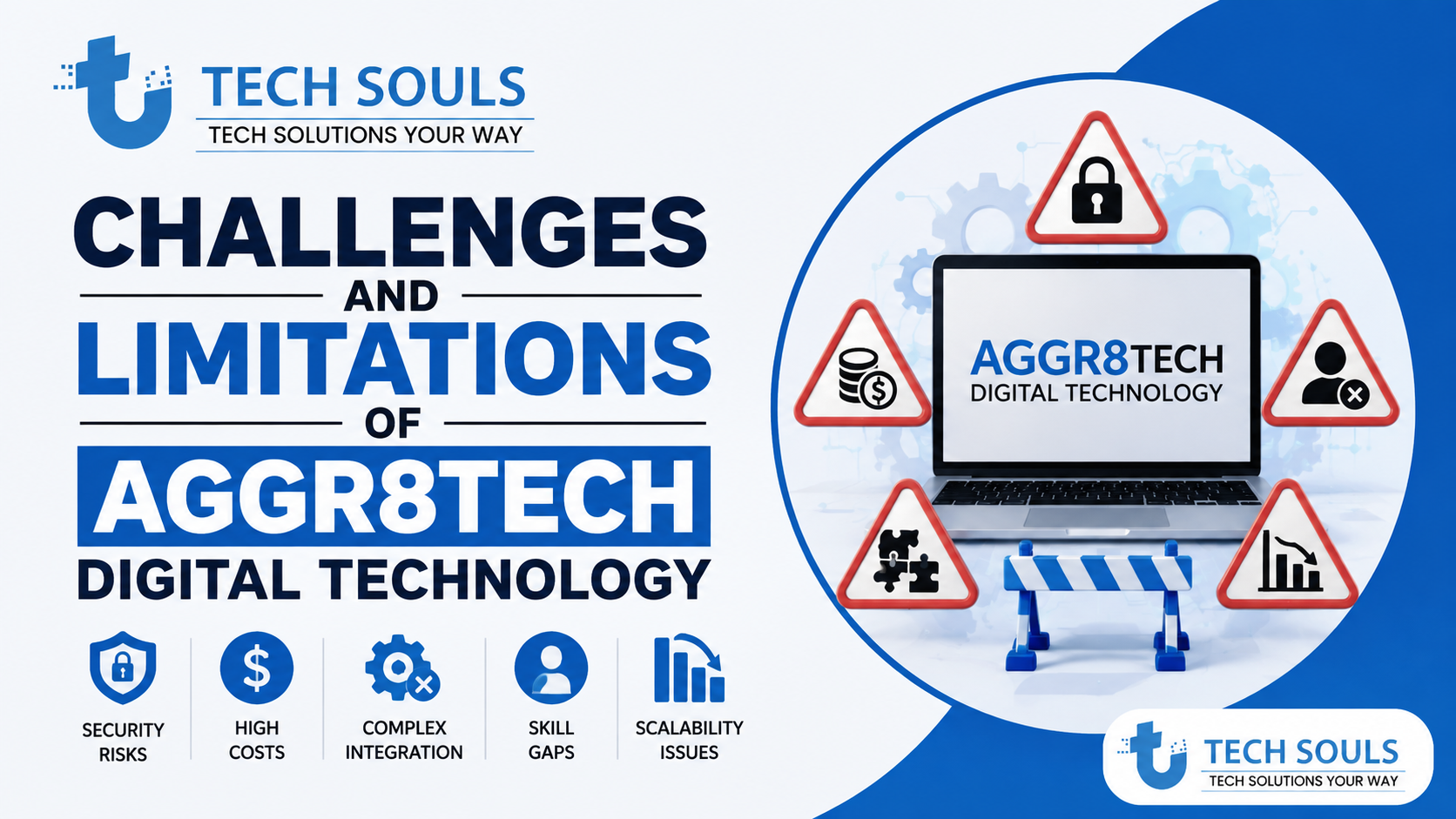
While Aggr8Tech Digital Technology offers significant advantages, successful implementation requires careful planning. Understanding the potential challenges helps organizations prepare realistic strategies and avoid costly mistakes.
1. Integration with Legacy Systems
Many businesses still rely on older software that was never designed to work with modern AI or cloud-based platforms.
Common issues include:
- Incompatible data formats
- Limited API support
- Manual data migration
- Performance bottlenecks
- Higher integration costs
Best Practice: Conduct a technology audit before implementation to identify compatibility issues and create a phased migration plan.
2. Employee Adoption
Technology alone does not guarantee success. Employees need time, training, and support to adapt to new workflows.
Organizations may face:
- Resistance to change
- Skill gaps
- Reduced productivity during the transition
- Lack of confidence in AI-driven tools
Solution: Provide hands-on training, clear documentation, and ongoing support to encourage adoption.
3. Cybersecurity and Data Privacy
As more business data moves to cloud platforms and connected systems, protecting sensitive information becomes increasingly important.
Organizations should implement:
- Multi-factor authentication (MFA)
- Data encryption
- Role-based access control
- Regular security updates
- Continuous monitoring
- Backup and disaster recovery plans
Security should be integrated into every stage of digital transformation rather than treated as an afterthought.
4. Initial Investment
Although digital transformation often reduces long-term operational costs, the upfront investment can be substantial.
Typical expenses include:
- Software licensing
- Cloud infrastructure
- Staff training
- Integration services
- Hardware upgrades
- Ongoing maintenance
Businesses should evaluate both the short-term costs and the long-term return on investment (ROI).
5. Data Quality
AI systems perform best when they receive accurate and consistent data.
Poor-quality data can lead to:
- Incorrect predictions
- Inaccurate reports
- Inefficient automation
- Poor customer experiences
Before implementing AI-driven solutions, organizations should establish strong data governance practices.
Best Practices for Successful Adoption
Successful digital transformation focuses on solving business problems—not simply adopting the latest technology.
Define Clear Business Goals
Start by identifying measurable objectives, such as:
- Reducing operational costs
- Improving customer satisfaction
- Increasing productivity
- Accelerating decision-making
- Enhancing data accuracy
Technology should support these goals rather than become the goal itself.
Start Small and Scale Gradually
Avoid transforming every department at once.
Instead:
- Choose one business process.
- Implement the solution.
- Measure results.
- Gather employee feedback.
- Improve the process.
- Expand to additional departments.
A phased rollout reduces risk and makes change easier to manage.
Prioritize Employee Training
Even the best technology delivers limited value if employees don't understand how to use it.
Provide:
- Practical workshops
- User guides
- Internal documentation
- Video tutorials
- Continuous learning opportunities
Employees who understand the benefits of new systems are more likely to embrace change.
Monitor Performance Continuously
Digital transformation is an ongoing journey.
Track key performance indicators (KPIs), such as:
- Process completion time
- Customer satisfaction
- Automation success rate
- System uptime
- Employee productivity
- Operational costs
Use these insights to refine workflows and improve performance over time.
Build with Scalability in Mind
Select solutions that can grow with your organization.
Consider:
- Future user growth
- Additional business locations
- Increased data volumes
- Integration with new software
- Emerging technologies
Planning for scalability today can prevent expensive upgrades later.
Future Trends in Aggr8Tech Digital Technology
Digital technology continues to evolve rapidly. Several emerging trends are likely to shape the future of integrated business platforms.
Smarter Artificial Intelligence
AI is becoming more capable of:
- Understanding natural language
- Generating business insights
- Predicting customer behavior
- Assisting with strategic planning
- Supporting decision-making
Rather than replacing employees, AI is expected to become a collaborative tool that enhances productivity.
Hyperautomation
Businesses are moving beyond automating individual tasks toward automating entire workflows.
Hyperautomation combines:
- AI
- Machine learning
- Robotic Process Automation (RPA)
- Analytics
- Process mining
This approach creates end-to-end automation across multiple departments.
Edge Computing
As IoT devices generate more data, processing information closer to where it is created reduces latency and improves real-time performance.
Industries expected to benefit include:
- Manufacturing
- Healthcare
- Logistics
- Smart cities
Predictive Analytics
Organizations are increasingly using historical data to forecast future outcomes.
Common applications include:
- Demand forecasting
- Inventory optimization
- Customer retention
- Risk management
- Preventive maintenance
Predictive analytics enables businesses to make proactive decisions instead of reacting to events after they occur.
Sustainable Technology
Modern organizations are placing greater emphasis on environmentally responsible technology.
Examples include:
- Energy-efficient cloud infrastructure
- Smart resource management
- Paperless workflows
- Optimized logistics
- Reduced hardware waste
Sustainability is becoming an important consideration alongside efficiency and profitability.
Frequently Asked Questions (FAQs)
What is Aggr8Tech Digital Technology?
Aggr8Tech Digital Technology is a digital transformation approach that combines AI, automation, cloud computing, analytics, and connected business systems to improve operational efficiency and support smarter decision-making.
Is Aggr8Tech a software platform?
The term is generally used to describe an integrated technology approach rather than a single universally recognized software product. Depending on the context, it may refer to a platform, framework, or ecosystem that brings together multiple digital technologies.
How does Aggr8Tech improve business operations?
It improves operations by automating repetitive tasks, connecting different software systems, providing real-time insights, and helping organizations make faster, data-driven decisions.
Which industries can benefit from Aggr8Tech?
Industries such as healthcare, retail, manufacturing, finance, logistics, education, and professional services can all benefit from integrated digital technologies.
Is Aggr8Tech suitable for small businesses?
Yes. Small businesses can begin with a limited implementation focused on one process—such as customer relationship management or workflow automation—and expand as their needs grow.
Does Aggr8Tech replace employees?
No. Its primary purpose is to automate repetitive work and provide better insights, allowing employees to focus on strategic, creative, and customer-facing responsibilities.
What technologies are commonly associated with Aggr8Tech?
Common technologies include:
- Artificial Intelligence (AI)
- Machine Learning (ML)
- Cloud Computing
- Automation
- Data Analytics
- Internet of Things (IoT)
- Cybersecurity
- Business Intelligence
Key Takeaways
- Aggr8Tech Digital Technology combines AI, automation, cloud computing, and analytics into a connected ecosystem.
- It helps businesses improve efficiency, scalability, and decision-making.
- Successful adoption requires clear objectives, employee training, and strong data governance.
- Organizations should implement digital transformation gradually and monitor performance continuously.
- Future innovations such as hyperautomation, predictive analytics, and edge computing will continue to expand the capabilities of integrated digital technologies.
Conclusion
Aggr8Tech Digital Technology represents a modern approach to digital transformation by bringing together intelligent technologies that help businesses operate more efficiently and adapt to changing market demands.
Rather than viewing AI, automation, cloud computing, and analytics as separate tools, organizations can achieve greater value by integrating them into a unified digital ecosystem. This connected approach improves collaboration, reduces manual work, supports data-driven decision-making, and creates a foundation for long-term growth.
For businesses beginning their digital transformation journey, the most effective strategy is to start with clear objectives, implement solutions in phases, and continuously measure results. Technology should always serve business goals—not the other way around.
As artificial intelligence and automation continue to evolve, organizations that invest in scalable, secure, and well-integrated digital solutions will be better positioned to innovate, remain competitive, and deliver greater value to both employees and customers.
Final Thoughts
Digital transformation is not a one-time project—it's an ongoing process of improving how people, processes, and technology work together. Whether you're a small business exploring automation or a large enterprise modernizing legacy systems, understanding the principles behind Aggr8Tech Digital Technology can help you make more informed technology decisions for the future.
Continue Exploring TechSouls
Technology is constantly evolving, and staying informed helps you make better decisions whether you're interested in software, AI, cybersecurity, gadgets, or the latest tech trends. At TechSouls, we regularly publish in-depth guides, tutorials, troubleshooting articles, and breaking technology news to keep you updated with accurate and practical information. If you found this article helpful, explore more of our latest content below to expand your knowledge and stay ahead in the fast-changing world of technology.
[Why Was Innerlifthunt Game Postponed? Complete Update (2026)]
[GDTJ45 Builder Software Guide (2026): Features & How It Works]
[Meetshaxs Performance Optimization: Boost Speed in 2026]
[DualMedia Mobile App Guide: Features, Safety & Availability]
[Best Internet Setup for Gamers: Low Ping & Stable Speed]
[Social Media Stuff EmbedTree Features and Setup Guide 2026]
[Evolution of Digital Technology: Trends, AI and Innovation (2026)]