How to Create a Social Media Strategy That Actually Works in 2026
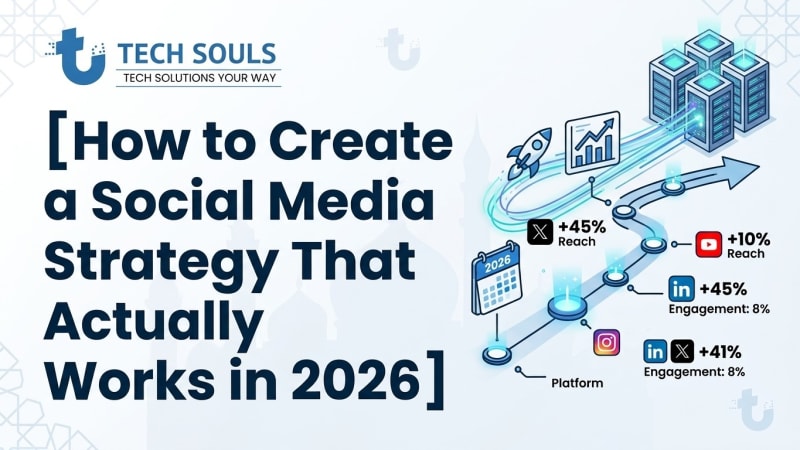
A social media strategy is a structured plan for using social platforms to achieve specific business goals. It defines who you want to reach, what you want to achieve, which platforms you should use, what content you will publish, how you will engage your audience, and which KPIs you will track.
Without a strategy, social media can quickly become a cycle of posting whenever you have an idea and hoping something works. A good strategy turns those random activities into a repeatable system.
Quick Answer: How Do You Create a Social Media Strategy?
To create a social media strategy:
- Define your business goals.
- Set measurable social media objectives.
- Research your target audience.
- Audit your existing social accounts.
- Analyze your competitors.
- Choose the right social media platforms.
- Create content pillars and formats.
- Build a content calendar.
- Define your engagement strategy.
- Track KPIs and continuously improve your strategy.
The key is to connect every social media activity to a business objective instead of focusing only on followers or likes.
What Is a Social Media Strategy?
A social media strategy is a long-term framework that explains how a business will use social platforms to reach its audience and support business goals.
It normally covers:
- Business goals
- Social media objectives
- Target audience
- Audience research
- Platform selection
- Content strategy
- Content pillars
- Posting schedule
- Community engagement
- Campaign planning
- Performance tracking
- KPIs and metrics
- Conversion and ROI measurement
Think of it as a roadmap.
Your strategy explains where you want to go and why, while your social media plan explains what you will publish, when you will publish it, and who will handle it.
Social Media Strategy vs. Social Media Plan
These terms are often used interchangeably, but they are not exactly the same.
| Social Media Strategy | Social Media Plan |
| Defines the overall direction | Defines specific actions |
| Focuses on why | Focuses on what and when |
| Connects social media to business goals | Organizes campaigns and content |
| Usually longer-term | Often short- or medium-term |
| Defines audience and positioning | Defines posts and publishing dates |
| Determines KPIs | Tracks execution and results |
For example, your strategy may be to use LinkedIn to generate qualified B2B leads.
Your plan might then include three LinkedIn posts per week, one case study per month, and a lead-generation campaign during the next quarter.
Why Your Business Needs a Social Media Strategy
Social media can generate awareness, engagement, traffic, leads, and sales. But simply having accounts on multiple platforms does not create those results.
A strategy helps you:
Avoid Random Posting
Instead of asking:
“What should we post today?”
you can ask:
“Which content should we publish to support this month's objective?”
That small change creates much more focused marketing.
Reach the Right Audience
Not every platform is equally useful for every business.
A B2B software company may find LinkedIn more valuable than TikTok, while a fashion brand may get more value from Instagram and short-form video.
The right choice depends on your audience, offer, content capabilities, and business goals.
Create Consistent Content
Content pillars give your team repeatable topics to work with.
This reduces the pressure to constantly invent completely new ideas.
Measure Business Results
A strategy gives you a reason to track metrics.
Instead of celebrating 10,000 views automatically, you can ask:
- Did those views reach the right people?
- Did users visit the website?
- Did they engage?
- Did they become leads?
- Did those leads generate revenue?
That is the difference between measuring activity and measuring performance.
The 10-Step Social Media Strategy Framework
1. Define Your Business Goals
Start with the business, not the social platform.
Ask what you actually want social media to accomplish.
Possible goals include:
- Increase brand awareness
- Generate qualified leads
- Increase website traffic
- Generate ecommerce sales
- Build a community
- Improve customer retention
- Establish industry authority
- Support product launches
- Improve customer communication
For example:
Weak goal:
Get more followers.
Better goal:
Generate more qualified website leads from social media.
Follower growth can still matter, but it should support a meaningful business objective.
2. Turn Goals Into Social Media Objectives
A business goal is broad. A social media objective should be specific and measurable.
For example:
Business goal: Generate more leads.
Social media objective: Generate 100 qualified website leads from organic and paid social campaigns within 90 days.
A useful objective should answer:
- What?
- How much?
- By when?
- Through which channel?
This makes performance much easier to evaluate.
3. Research Your Target Audience
A social media strategy becomes much stronger when you understand the people you want to reach.
Research:
- Age range
- Location
- Job or industry
- Interests
- Problems
- Goals
- Buying concerns
- Preferred content formats
- Frequently used platforms
- Questions they ask
- Reasons they may reject your product
Go beyond basic demographics.
For example, saying:
“Our audience is business owners aged 25–45”
is not enough.
A more useful audience profile might be:
“Small-business owners who need more website leads but do not have an internal marketing team and want practical, affordable digital marketing solutions.”
That description gives you ideas for content.
Use Audience Personas
You can create simple personas such as:
Persona: Small Business Owner
Problem: Inconsistent online leads
Goal: Generate predictable enquiries
Concern: Marketing costs
Useful content: Marketing guides, case studies, checklists, practical tips
This information can guide your entire social media content strategy.
4. Audit Your Existing Social Media Presence
Before creating a new strategy, examine what you already have.
Review:
- Profile optimization
- Followers
- Reach
- Engagement
- Best-performing posts
- Worst-performing posts
- Posting frequency
- Content formats
- Website clicks
- Leads
- Conversion data
- Brand consistency
Ask:
What is working well?
Which areas are not delivering the expected results?
Are there any activities we should stop?
What should we do more often to improve results?
Your audit should produce decisions, not just numbers.
5. Perform a Social Media Competitor Analysis
Competitor analysis should not mean copying another company's posts.
Instead, identify patterns.
Review competitors for:
- Platforms
- Posting frequency
- Content themes
- Content formats
- Engagement levels
- Offers
- Brand positioning
- Customer comments
- Popular topics
- Weak content areas
Look for gaps.
For example, if competitors mostly publish promotional posts, you could differentiate with:
- Educational guides
- Original research
- Tutorials
- Case studies
- Customer questions
- Industry explanations
The objective is not:
“What can we copy?”
It is:
“What useful value are competitors missing?”
6. Choose the Right Social Media Platforms
You do not need to be active on every platform.
Choose platforms based on:
Audience + Business Goal + Content Format + Available Resources
Platform Strategy
| Platform | Often Useful For | Content Opportunities |
| Visual brands, creators, ecommerce | Reels, carousels, stories | |
| Communities, local businesses, broad audiences | Posts, groups, video | |
| B2B and professional audiences | Insights, case studies, documents | |
| TikTok | Discovery and short-form video | Short videos, educational content |
| YouTube | Education, search, demonstrations | Tutorials, reviews, long-form video |
These are starting points, not universal rules.
A platform is valuable only when your audience is there and you can consistently create content that fits the platform.
7. Build Your Social Media Content Strategy
Your content strategy defines what you will communicate and why.
Start with content pillars.
Example Content Pillars for a Digital Agency
1: Education
- SEO tips
- Website optimization
- Digital marketing guides
2: Expertise
- Industry insights
- Technical explanations
- Expert opinions
3: Proof
- Case studies
- Before-and-after examples
- Project lessons
4: Community
- Questions
- Polls
- Discussions
- Customer stories
5: Promotion
- Services
- Offers
- Product updates
- Consultation opportunities
A balanced strategy prevents every post from becoming an advertisement.
Match Content to the Customer Journey
Different users need different types of content.
| Buyer Stage | Content Type |
| Awareness | Educational posts, trends, short videos |
| Consideration | Comparisons, guides, case studies |
| Decision | Testimonials, demos, service explanations |
| Retention | Tutorials, updates, customer support content |
This creates a stronger content funnel.
8. Create a Content Calendar and Posting Schedule
A social media content calendar turns your strategy into an execution system.
A simple weekly calendar might look like this:
| Day | Content | Goal |
| Monday | Educational carousel | Awareness |
| Tuesday | Short video | Reach |
| Wednesday | Industry insight | Authority |
| Thursday | Customer question | Engagement |
| Friday | Case study | Consideration |
| Saturday | Behind-the-scenes content | Community |
| Sunday | Repurposed evergreen content | Reach |
Do not treat this schedule as a universal rule.
Your ideal posting frequency depends on:
- Audience behavior
- Platform
- Content quality
- Team capacity
- Performance data
Publishing five weak posts is not automatically better than publishing three strong ones.
9. Create an Engagement Strategy
Social media is not just a publishing channel.
Your strategy should explain how you will interact with people.
Include:
- Replying to comments
- Responding to messages
- Answering questions
- Joining relevant conversations
- Encouraging discussions
- Mentioning customers
- Monitoring brand mentions
- Building a community
For example, if someone asks a detailed question under a LinkedIn post, a one-word response wastes an opportunity.
A useful answer can demonstrate expertise and encourage further discussion.
Community Management Matters
Engagement should feel like a conversation rather than automated broadcasting.
Your goal is not simply to increase comment numbers.
Your goal is to build relationships with people who may eventually become customers, advocates, or repeat visitors.
10. Measure, Learn, and Optimize
Your strategy should never be “set and forget.”
Review performance regularly.
Look at:
- Reach
- Impressions
- Engagement
- Saves
- Shares
- Comments
- Profile visits
- Link clicks
- Website sessions
- Leads
- Conversions
- Revenue
- Follower growth
Then ask:
- Which activities deserve more attention?
- Where can your current strategy be improved?
- Are there any tactics worth removing?
- Which audience segment shows the strongest response?
- Which types of content contribute most to business growth?
This turns analytics into an optimization system.
How to Choose the Right Social Media KPIs
The best KPI depends on the goal.
| Business Goal | Useful KPIs |
| Brand awareness | Reach, impressions, video views |
| Engagement | Comments, shares, saves, engagement rate |
| Website traffic | Link clicks, sessions, click-through rate |
| Lead generation | Leads, conversion rate, cost per lead |
| Sales | Revenue, purchases, conversion rate, ROAS |
| Community building | Replies, mentions, returning participants |
Do not track dozens of metrics simply because your analytics dashboard provides them.
Track the metrics that help you make decisions.
Vanity Metrics vs Business Metrics
A vanity metric can look impressive without proving business impact.
For example:
10,000 views sounds good.
But if the content reached the wrong audience and generated no meaningful action, its business value may be limited.
A better measurement chain is:
Reach → Engagement → Clicks → Leads → Customers → Revenue
This does not mean reach and engagement are useless. They simply need to be interpreted in context.
Social Media Strategy Example
Imagine a SaaS company selling project management software to small businesses.
Business Goal
Generate qualified product demos.
Target Audience
Small-business managers and operations teams.
Platforms
LinkedIn and YouTube.
Content Pillars
- Productivity education
- Project management tips
- Product tutorials
- Customer problems
- Case studies
Weekly Content
- 2 LinkedIn educational posts
- 1 case study
- 1 short product video
- 1 longer YouTube tutorial
KPIs
- Website clicks
- Demo requests
- Qualified leads
- Conversion rate
- Cost per lead for paid campaigns
Notice that the strategy is built around business outcomes, not simply follower growth.
Organic vs Paid Social Media Strategy
Both can be useful, but they serve different purposes.
| Organic Social | Paid Social |
| Builds long-term audience | Can accelerate reach |
| Relies on content and engagement | Uses advertising budget |
| Useful for authority | Useful for targeted campaigns |
| Compounds over time | Can produce faster testing |
| Lower direct media cost | Requires ad spend |
A strong business strategy may use both.
For example:
Organic content → identifies high-performing topics → paid campaign amplifies proven content → landing page converts traffic.
How to Measure Social Media ROI
Social media ROI becomes easier to understand when you connect activity to revenue.
A simplified formula is:
ROI = (Revenue generated − Marketing cost) ÷ Marketing cost × 100
For example, if a campaign generates $5,000 in attributable revenue and costs $2,000:
ROI = ($5,000 − $2,000) ÷ $2,000 × 100 = 150%
In real campaigns, attribution can be more complicated. A customer may interact with several channels before converting.
Therefore, use tracking systems such as:
- UTM parameters
- Analytics platforms
- CRM records
- Conversion tracking
- Platform analytics
- Landing-page data
The goal is to understand the customer journey rather than blindly assign every conversion to the last click.
30-Day Social Media Strategy Implementation Plan
You do not have to build everything in one day.
1: Research
- Define business goals
- Research your audience
- Audit existing accounts
- Analyze competitors
- Identify platform opportunities
2: Strategy
- Select platforms
- Define content pillars
- Establish brand voice
- Choose content formats
- Define KPIs
3: Content
- Build the content calendar
- Create posts
- Prepare visual assets
- Write captions
- Schedule content
4: Launch and Measure
- Publish consistently
- Respond to your audience
- Monitor performance
- Identify winning content
- Record insights
- Adjust the next month's strategy
This approach is more sustainable than trying to create an entire year's content calendar immediately.
Common Social Media Strategy Mistakes
1. Trying to Use Every Platform
More platforms mean more work.
Focus on the platforms that actually matter to your audience.
2. Focusing Only on Followers
A smaller relevant audience can be more valuable than a huge unrelated following.
3. Copying Competitors
Competitor analysis should identify opportunities, not encourage duplication.
4. Posting Without a Goal
Every important content category should have a purpose.
5. Using the Same Content Everywhere
A successful LinkedIn post may need a different format for TikTok or Instagram.
Repurpose the idea, but adapt the execution.
6. Ignoring Comments and Messages
Publishing without interaction turns social media into a one-way broadcast channel.
7. Tracking Too Many Metrics
More data does not automatically mean better decisions.
Choose KPIs connected to your objectives.
8. Expecting Immediate Results
Some content can generate quick traffic, while authority, community, and organic growth often require consistent effort.
Pro Tips for a Better Social Media Strategy
Start With One Clear Objective
If everything is a priority, nothing is.
Choose the most important outcome for the current campaign or period.
Create More From What Already Works
If a topic performs well, explore it from different angles.
One strong idea can become:
- Carousel
- Short video
- Blog article
- LinkedIn post
- FAQ
- Infographic
Build Content Around Customer Questions
Customer questions are a natural source of content ideas.
Check:
- Sales conversations
- Customer support questions
- Comments
- Reviews
- Community discussions
- Search queries
Test Before Scaling
Do not spend heavily on an untested idea.
Test content, audience, offer, and messaging first. Then invest more in what produces meaningful results.
Review Your Strategy Monthly
Your strategy should evolve as you collect more data.
A monthly review can identify:
- Winning topics
- Weak formats
- Strong platforms
- Audience changes
- Conversion opportunities
- New content gaps
Social Media Strategy Checklist
Before launching your strategy, make sure you can answer:
- What is our primary business goal?
- What social media objectives support that goal?
- Who is our target audience?
- What problems do they have?
- Which platforms do they use?
- What are our competitors doing?
- What content gaps can we target?
- What are our content pillars?
- What formats will we use?
- How often can we realistically publish?
- How will we engage with the audience?
- Which KPIs will we track?
- How will we measure website conversions?
- How will we calculate or estimate ROI?
- When will we review and improve the strategy?
FAQs About Social Media Strategy
What is a social media strategy?
A social media strategy is a structured plan for using social platforms to achieve business goals. It covers your audience, objectives, platforms, content, engagement approach, KPIs, measurement, and optimization process.
How do I create a social media strategy?
Start by defining your business goal, researching your target audience, auditing existing accounts, analyzing competitors, selecting relevant platforms, creating content pillars, building a calendar, setting KPIs, and reviewing performance.
What are the main components of a social media strategy?
The main components include business goals, social media objectives, audience research, competitor analysis, platform selection, content strategy, content calendar, engagement, campaigns, KPIs, analytics, and optimization.
How often should a business post on social media?
There is no universal posting frequency that works for every business. Start with a schedule your team can maintain consistently, then use audience engagement and performance data to determine whether frequency should increase or decrease.
Which social media platform is best for a business?
The best platform depends on your target audience, business model, goals, content format, and available resources. B2B companies may benefit from LinkedIn, while visual or consumer brands may find Instagram or TikTok more suitable.
What social media KPIs should I track?
Track KPIs based on your goal. Awareness campaigns may focus on reach and impressions, engagement campaigns on comments and shares, traffic campaigns on clicks, and lead-generation campaigns on leads and conversion rate.
How long does a social media strategy take to work?
There is no fixed timeline. Some campaigns can generate immediate engagement or traffic, while organic audience growth, authority, and community building usually require consistent effort and testing.
What is the difference between a social media strategy and a social media content strategy?
A social media strategy covers the broader business approach, including goals, audience, platforms, KPIs, and measurement. A social media content strategy focuses specifically on what content you will create, why you will create it, and how it will support those goals.
Key Takeaways
A successful social media strategy is not simply a list of platforms and posting times.
It is a connected system:
Business Goals → Audience → Platforms → Content → Engagement → Measurement → Optimization
The most important principles are:
- Start with business goals.
- Understand your audience before creating content.
- Choose platforms strategically.
- Build clear content pillars.
- Create a realistic publishing schedule.
- Measure meaningful KPIs.
- Connect social activity with conversions where possible.
- Learn from performance data.
- Avoid copying competitors.
- Improve the strategy continuously.
Conclusion
The best social media strategy is not necessarily the one that produces the most posts or followers. It is the one that consistently connects the right audience with useful content and moves them toward a meaningful business outcome.
Start small. Choose the platforms that matter most, define a few strong content pillars, create a manageable calendar, and track the metrics that actually support your goals.
As your data improves, your strategy should improve with it.
Social media becomes much more effective when you stop treating it as a place to publish posts and start treating it as a measurable part of your overall marketing system.
Continue With TechSouls
If you found this social media strategy guide useful, explore more practical articles from TechSouls covering digital marketing, web design, SEO, and modern technology.
Discover our latest guides to improve your online presence, strengthen your digital strategy, and grow your business with the right technology.
Explore more from TechSouls:
- Digital Marketing
- Web Design & Development
- SEO & Online Growth
- Business Technology
- AI & Automation
Read more:
[Fast & SEO-Friendly: Best Frontend Frameworks 2026]
[Cybersecurity Updates 2026: Latest Threats & Protection Tips]
[Droven io AI News: Top Trends & Breakthroughs 2026]
[Gesture Recognition Technology: Types, Uses & How It Works]
[DevOps Consulting Services: Benefits, Cost & Process]
[Evolution of Digital Technology: Trends, AI and Innovation (2026)]
[Information About Foxtpax Software: Complete Guide (2026)]
[Endbugflow Software: Features, Benefits & How It Works]
[Aggr8Tech Digital Technology: Features, Benefits & Uses (2026)]