How to Develop Oxzep7 Software: A Complete Step-by-Step Guide
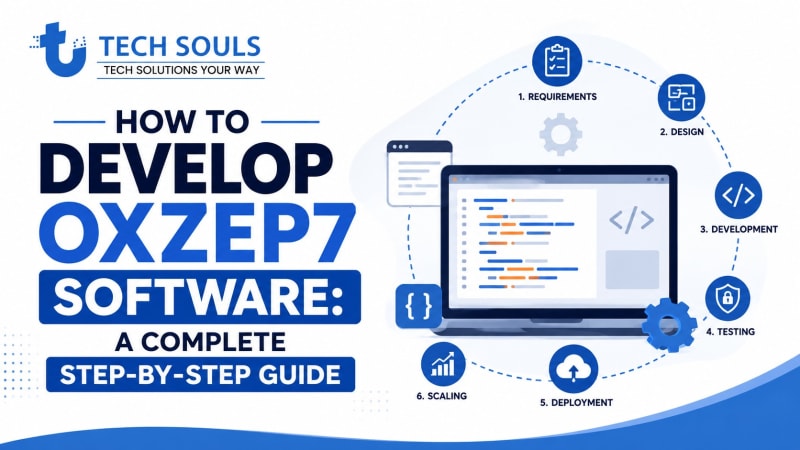
Developing Oxzep7 software starts with defining exactly what the application is supposed to do, who will use it, and which problems it needs to solve. From there, the development process typically includes requirements analysis, architecture design, technology selection, database development, frontend and backend programming, API integration, security, testing, deployment, monitoring, and ongoing maintenance.
One important point comes first: publicly verifiable technical documentation for a standardized Oxzep7 software product is limited. That means developers should not assume a specific programming language, architecture, database, or feature set is officially required. Instead, the most reliable approach is to treat Oxzep7 as a software project whose architecture and technology stack should be selected according to its actual requirements.
This guide explains how to approach that development process practically.
Quick Answer: How Do You Develop Oxzep7 Software?
To develop Oxzep7 software:
- Define its purpose and target users.
- Document functional and non-functional requirements.
- Decide which features belong in the MVP.
- Design the application architecture.
- Select the programming language and technology stack.
- Design the database and data model.
- Develop the backend and APIs.
- Build the frontend or user interface.
- Add authentication and security controls.
- Test the application thoroughly.
- Deploy it through staging to production.
- Monitor, maintain, and improve it after release.
The exact implementation depends on what Oxzep7 is intended to accomplish.
What Is Oxzep7 Software?
Oxzep7 is not currently supported by enough widely available official technical documentation to confidently describe it as a standardized software product with a fixed architecture or official technology stack.
For development purposes, this distinction matters.
A developer should avoid statements such as "Oxzep7 officially uses Python" or "Oxzep7 requires a microservices architecture" unless those claims can be verified through authoritative documentation.
Instead, think of Oxzep7 as a software development target whose implementation should be driven by:
- Business requirements
- User workflows
- Required features
- Data requirements
- Security requirements
- Integration requirements
- Performance expectations
- Scalability needs
This approach prevents developers from choosing technologies first and trying to force the project around them later.
What You Need to Define Before Developing Oxzep7
Before writing source code, establish what the application actually needs to accomplish.
Define the Purpose
Start with one simple question:
What problem should Oxzep7 solve?
For example, suppose Oxzep7 is intended to be a workflow-management application. Its purpose might be to help teams organize tasks, automate repetitive processes, track progress, and generate reports.
That example is only a development scenario—not a claim about the actual purpose of Oxzep7.
A clear purpose helps determine almost every later technical decision.
Identify Target Users
Define who will use the software.
Possible user groups include:
- Administrators
- Employees
- Customers
- Managers
- Developers
- Analysts
- External partners
Different users may require different permissions and interfaces.
Document Functional Requirements
Functional requirements describe what the software must do.
Examples include:
- User registration
- Login
- Password recovery
- User profiles
- Dashboard
- Search
- Notifications
- Data management
- Reporting
- File uploads
- API integrations
- Administrative controls
Define Non-Functional Requirements
Non-functional requirements describe how the application should perform.
Examples include:
- Security
- Reliability
- Scalability
- Performance
- Availability
- Accessibility
- Maintainability
- Usability
For example, "users can create accounts" is a functional requirement, while "the application should respond quickly under normal traffic" is a performance requirement.
Build an MVP Before Building Everything
One of the easiest ways to make software development unnecessarily expensive is to build every possible feature before validating the core product.
A better strategy is to create a Minimum Viable Product (MVP).
A basic Oxzep7-style MVP might contain:
| Component | MVP Example |
| Authentication | Login and registration |
| User management | Profile and roles |
| Core feature | Main application workflow |
| Database | Persistent application data |
| API | Communication between frontend and backend |
| Dashboard | Basic status information |
| Security | Access control and secure credentials |
| Testing | Automated and manual tests |
| Deployment | Production-ready environment |
Once the MVP works reliably, additional functionality can be added.
Oxzep7 Software Development Process
A structured software development lifecycle reduces technical debt and makes the project easier to manage.
Step 1: Requirements Analysis
Start by converting the project's goals into measurable requirements.
Create a requirements document containing:
- Project objective
- Target users
- Core features
- User roles
- Data requirements
- Integrations
- Security requirements
- Performance expectations
- Deployment requirements
A simple requirement might look like:
"An authenticated user can create, edit, and delete their own records."
This is much more useful than simply writing:
"Add user management."
The first statement can be implemented and tested.
Step 2: Plan the Development Project
Break the project into manageable phases.
A practical sequence is:
Requirements
↓
Architecture
↓
Database
↓
Backend/API
↓
Frontend
↓
Security
↓
Testing
↓
Deployment
↓
Monitoring
Assign milestones rather than attempting to build the entire application simultaneously.
Version control should also be established at the beginning rather than after development has already started.
Step 3: Design the Application Architecture
Architecture defines how the major parts of the software communicate.
A common web application might look like this:
User
↓
Frontend
↓
API Layer
↓
Business Logic
↓
Database
↓
External Services
For example, a user might submit information through a React interface. The frontend sends an HTTP request to the backend API. The backend validates the request, applies business rules, communicates with the database, and returns a response.
Keeping these responsibilities separated makes the application easier to test and maintain.
Choosing the Right Technology Stack
There is no universally "best" technology stack for Oxzep7.
The correct choice depends on the project's requirements.
Frontend Technologies
Potential options include:
- React
- Vue
- Angular
- HTML/CSS/JavaScript
- Next.js
For a modern interactive web application, React or another component-based framework may be appropriate.
However, a simpler application may not need a complex frontend framework at all.
Backend Technologies
Possible choices include:
- Python
- Node.js
- Java
- C#
- PHP
- Go
Python can be particularly useful when the project involves automation, data processing, AI, or machine-learning components.
Node.js can be attractive for teams already working heavily with JavaScript or TypeScript.
The technology should follow the requirements rather than personal preference alone.
Database Options
Possible databases include:
- PostgreSQL
- MySQL
- MongoDB
- SQLite
- Redis for caching or specific high-speed data requirements
A relational database such as PostgreSQL is generally a strong option when the application depends on structured relationships and transactional consistency.
A document database may make more sense when the data model is highly flexible.
Monolithic vs Microservices Architecture
This is one of the most important architecture decisions.
Monolithic Architecture
A monolithic application keeps major components within one deployable application.
Advantages
- Easier initial development
- Simpler deployment
- Lower operational complexity
- Easier local development
- Good choice for many MVPs
Disadvantages
- Large applications can become difficult to maintain
- Individual components are less independently deployable
- Scaling specific services can be harder
Microservices Architecture
Microservices divide an application into independently deployable services.
For example:
Authentication Service
↓
User Service
↓
Core Application Service
↓
Reporting Service
↓
Notification Service
Advantages
- Independent deployment
- Independent scaling
- Service-level isolation
- Useful for large distributed systems
Disadvantages
- More infrastructure
- More monitoring requirements
- Network communication between services
- More complicated deployment
- Greater debugging complexity
Which Should Oxzep7 Use?
If the project is small or still being validated, a modular monolith is often a more practical starting point than immediately adopting microservices.
Move toward microservices when there is a genuine architectural or scaling reason—not simply because microservices sound more advanced.
Database Design and Data Management
A poorly designed database can create performance and maintenance problems later.
Start by identifying the major entities.
For example:
Users
Projects
Tasks
Activities
Notifications
Reports
Then determine the relationships between them.
A user might own multiple projects, while each project could contain multiple tasks.
Database Best Practices
Use appropriate indexes
Indexes can improve query performance, particularly for frequently searched or filtered fields.
Validate data
Do not rely exclusively on frontend validation. Important validation should also happen on the server.
Use backups
Production data should have a reliable backup and recovery strategy.
Avoid unnecessary duplication
Poorly planned duplication can create inconsistent records and complicated updates.
Monitor slow queries
As the application grows, database performance should be measured rather than guessed.
Backend Development
The backend handles the application's core logic and data processing.
Typical backend responsibilities include:
- Authentication
- Authorization
- Business logic
- Database operations
- API endpoints
- Validation
- Error handling
- Logging
- External service integration
For example:
POST /api/users
GET /api/users
GET /api/projects
POST /api/projects
PUT /api/projects/{id}
DELETE /api/projects/{id}
The exact endpoints depend on the application's requirements.
A well-designed API should use predictable naming, appropriate HTTP methods, meaningful status codes, validation, and consistent error responses.
Frontend Development
The frontend is the part users interact with directly.
Typical components include:
- Navigation
- Login page
- Dashboard
- Forms
- Tables
- Search
- Notifications
- Settings
- Reports
The interface should prioritize usability rather than simply adding as many features as possible.
For example, a dashboard should answer important user questions quickly:
- What needs attention?
- What changed?
- What is completed?
- What action should I take next?
API Integration
APIs allow different software components to communicate.
A typical request might follow this path:
User clicks button
↓
Frontend sends API request
↓
Backend authenticates request
↓
Business logic executes
↓
Database operation
↓
Backend returns response
↓
Frontend updates interface
If Oxzep7 requires third-party services, APIs might also be used for:
- Payment processing
- Maps
- AI services
- Analytics
- Cloud storage
- Authentication providers
External APIs should be treated as dependencies that can fail. The application should therefore handle timeouts, errors, rate limits, and unavailable services gracefully.
Authentication and Security
Security should be included from the beginning, not added immediately before launch.
Important areas include:
Authentication
Verify who the user is.
Authorization
Determine what that authenticated user is allowed to access.
Password Security
Never store passwords as plain text. Use established password-hashing mechanisms.
Input Validation
Validate untrusted input on the server.
HTTPS
Use encrypted communication between clients and production services.
Secrets Management
API keys, database passwords, tokens, and other credentials should not be committed directly into source code.
Dependency Security
Third-party libraries should be monitored and updated when vulnerabilities are discovered.
The current OWASP Top 10:2025 provides a useful reference for major web application security risks, including broken access control, security misconfiguration, software supply-chain failures, cryptographic failures, injection, and authentication failures.
Security should therefore be treated as a continuous development responsibility rather than a final checklist item.
Testing Oxzep7 Software
Testing determines whether the application actually behaves as expected.
| Testing Type | Purpose |
| Unit testing | Tests individual functions or components |
| Integration testing | Tests multiple components together |
| API testing | Tests backend endpoints |
| System testing | Tests the complete application |
| User acceptance testing | Confirms business requirements |
| Security testing | Identifies security weaknesses |
| Performance testing | Measures behavior under load |
| Regression testing | Ensures new changes don't break existing features |
Unit Testing
Test individual functions independently.
For example, if the application contains a function that calculates a project score, test normal values, edge cases, invalid inputs, and expected errors.
Integration Testing
Check whether components work together correctly.
For example:
Frontend
↓
API
↓
Authentication
↓
Business Logic
↓
Database
User Acceptance Testing
Technical correctness isn't enough.
Real users should confirm that the software actually solves the problem it was designed to solve.
Debugging Common Development Problems
Software development inevitably produces bugs.
A useful debugging process is:
- Reproduce the problem.
- Record the exact error.
- Identify where it occurs.
- Check logs.
- Isolate the component.
- Fix the underlying cause.
- Test the fix.
- Add a regression test when appropriate.
For example, if an API returns a database connection error, don't immediately modify random configuration values.
Check:
- Database availability
- Connection string
- Credentials
- Network access
- Environment variables
- Database logs
- Application logs
Systematic debugging is faster than trial and error.
Deployment and Release Strategy
Don't deploy directly from a developer's laptop to production without a controlled process.
A better environment structure is:
Development
↓
Staging
↓
Production
Development
Used for active coding and experimentation.
Staging
Used to test a release in an environment similar to production.
Production
The live environment used by real users.
A deployment pipeline can automate:
- Building
- Testing
- Security checks
- Packaging
- Deployment
- Rollback
CI/CD can make releases more consistent and reduce manual errors.
Performance Optimization
Performance optimization should be based on measurements.
Don't optimize code simply because something "looks slow."
Important areas include:
Database Queries
Review slow queries and indexes.
Caching
Frequently accessed data may be cached when appropriate.
API Performance
Reduce unnecessary processing and avoid inefficient API calls.
Frontend Performance
Reduce unnecessary JavaScript, optimize assets, and avoid loading resources users don't immediately need.
Background Processing
Long-running operations can sometimes be moved into background jobs rather than making users wait for the entire operation.
Scaling Oxzep7 Software
Scaling means preparing the application to handle increased users, traffic, data, or processing requirements.
Vertical Scaling
Increase the resources of an existing server.
Examples include:
- More CPU
- More RAM
- Faster storage
Horizontal Scaling
Add additional application instances.
For example:
Load Balancer
/ | \
/ | \
Server 1 Server 2 Server 3
\ | /
Database
Other Scaling Techniques
Depending on the application, scaling may involve:
- Caching
- Database optimization
- Read replicas
- Load balancing
- Queues
- Background workers
- CDN usage
- Containerization
The best scaling strategy depends on the actual bottleneck.
Documentation Matters
Documentation is often ignored during development and regretted later.
Document:
- Project setup
- Environment variables
- Architecture
- Database schema
- API endpoints
- Authentication flow
- Deployment process
- Troubleshooting procedures
- Dependencies
- Major technical decisions
A new developer should be able to understand how to run and maintain the application without relying entirely on the original developer.
Version Control Best Practices
Use Git or another version-control system from the beginning.
A practical workflow might look like:
main
- feature/authentication
- feature/dashboard
- feature/api
- feature/reporting
Useful practices include:
- Small commits
- Descriptive commit messages
- Pull requests
- Code review
- Protected production branches
- Avoiding secrets in repositories
Version control is not just a backup system. It provides a history of how the software evolved.
Common Oxzep7 Development Mistakes
1. Coding Before Defining Requirements
Starting development without knowing the desired outcome often causes expensive rework.
2. Choosing Technology Based on Hype
A fashionable framework isn't automatically the correct framework.
Choose based on:
- Team expertise
- Project requirements
- Maintenance
- Ecosystem
- Performance
- Security
- Long-term support
3. Building Too Many Features
An oversized first release increases development time and complexity.
Start with the core user problem.
4. Using Microservices Too Early
Microservices can introduce operational complexity before the application actually needs them.
5. Ignoring Security
Security vulnerabilities can be extremely expensive to fix after production deployment.
6. Skipping Automated Testing
Manual testing alone becomes difficult as the application grows.
7. No Staging Environment
Testing changes directly in production increases risk.
8. Poor Documentation
If knowledge exists only in one developer's head, maintenance becomes difficult.
9. No Monitoring
A deployed application isn't finished. You need visibility into errors, performance, availability, and unusual behavior.
10. Treating Assumptions as Facts
This is especially important for an obscure project such as Oxzep7.
If the official architecture or features aren't documented, label your proposed implementation as a recommendation rather than presenting it as established fact.
Practical Oxzep7 Development Checklist
Use this checklist before considering the project production-ready.
Planning
- Define the purpose
- Identify users
- Document requirements
- Define the MVP
- Establish project milestones
Architecture
- Choose application architecture
- Design data flow
- Define API boundaries
- Plan authentication
- Identify third-party integrations
Development
- Configure development environment
- Initialize Git repository
- Build database
- Develop backend
- Develop APIs
- Build frontend
- Implement validation
- Implement error handling
Security
- Secure authentication
- Implement authorization
- Protect secrets
- Validate inputs
- Use HTTPS
- Review dependencies
- Test security controls
Testing
- Unit testing
- Integration testing
- API testing
- System testing
- User acceptance testing
- Performance testing
- Security testing
Deployment
- Configure staging
- Test production build
- Configure backups
- Establish monitoring
- Configure CI/CD
- Prepare rollback procedure
When Should You Not Use a Complex Architecture?
You don't necessarily need microservices, Kubernetes, multiple databases, event-driven architecture, or a large cloud infrastructure for every software project.
If Oxzep7 is a relatively small application, a simpler architecture can provide:
- Faster development
- Lower infrastructure costs
- Easier debugging
- Simpler deployment
- Easier maintenance
Complexity should solve a real problem.
Don't add architecture because it sounds impressive. Add it because the application's requirements justify it.
How Long Does It Take to Develop Oxzep7 Software?
There is no reliable universal development time because the term "Oxzep7 software" does not define a fixed feature set.
Development time depends on:
- Number of features
- Number of users
- Platform requirements
- Integrations
- Security requirements
- UI complexity
- Database complexity
- Team size
- Testing requirements
- Deployment environment
A small MVP might require significantly less work than a production-grade enterprise platform.
The best way to estimate the project is to break it into features and estimate each development phase separately.
Frequently Asked Questions
What is Oxzep7 software?
Oxzep7 appears to be an obscure or insufficiently documented software term. There is not enough authoritative public documentation to establish a fixed product definition, official architecture, or mandatory technology stack. Developers should therefore define the project's actual requirements before selecting technologies.
How do you develop Oxzep7 software?
Start with requirements and user workflows, define the MVP, design the architecture, choose an appropriate technology stack, develop the database, backend, frontend and APIs, implement security, test the application, deploy it, and continuously monitor and maintain it.
Which programming language is best for Oxzep7?
There is no objectively correct language without knowing the application's requirements. Python, JavaScript/TypeScript, Java, C#, Go, and PHP can all be appropriate for different software projects.
What tools are needed to develop Oxzep7 software?
A typical development environment may include a code editor, Git, a programming-language runtime, package manager, database, API testing tool, testing framework, CI/CD system, and deployment platform.
Should Oxzep7 use microservices?
Not necessarily. A modular monolith may be a better starting point for a small or early-stage application. Microservices become more attractive when independent scaling, deployment, team ownership, or system complexity creates a genuine need for them.
How important is software testing?
Testing is essential because it helps identify defects before they reach users. A mature project should combine unit, integration, API, system, security, performance, and user acceptance testing as appropriate.
Can Oxzep7 software be expanded later?
Yes. A well-designed application can be extended more easily when its architecture uses clear modules, well-defined APIs, maintainable code, appropriate database design, automated tests, and good documentation.
Should security be included from the beginning?
Yes. Authentication, authorization, input validation, secure credential handling, dependency management, and other security controls should be considered during architecture and development rather than added only before launch.
Key Takeaways
- Define Oxzep7's actual purpose before choosing technologies.
- Don't assume an undocumented technology stack is official.
- Start with requirements and an MVP.
- Choose architecture based on project complexity.
- A modular monolith can be a sensible starting point.
- Design the database before building dependent features.
- Keep frontend, backend, API, and business logic responsibilities clear.
- Implement security throughout development.
- Combine automated and manual testing.
- Use staging before production.
- Monitor the application after launch.
- Optimize based on measured performance problems.
- Document the system so it can be maintained by others.
- Scale only when actual requirements justify additional complexity.
Conclusion
Developing Oxzep7 software should not begin with a programming language or framework. It should begin with a clear understanding of the problem the software needs to solve.
Because publicly available technical information about Oxzep7 is limited, there is no reliable basis for claiming that it requires a particular architecture, database, programming language, or feature set. The more defensible approach is to build the project around verified requirements and select technologies accordingly.
A practical development path is straightforward:
requirements → MVP → architecture → technology stack → database → backend → frontend → APIs → security → testing → deployment → monitoring → maintenance.
Following this process helps keep the project maintainable without overengineering it. Whether Oxzep7 ultimately becomes a small internal application, a customer-facing platform, or a larger software system, the same principle applies: build around real requirements, measure results, secure the system from the beginning, and introduce complexity only when it creates measurable value.
Continue Exploring TechSouls
Technology is constantly evolving, and staying informed helps you make better decisions whether you're interested in software, AI, cybersecurity, gadgets, or the latest tech trends. At TechSouls, we regularly publish in-depth guides, tutorials, troubleshooting articles, and breaking technology news to keep you updated with accurate and practical information. If you found this article helpful, explore more of our latest content below to expand your knowledge and stay ahead in the fast-changing world of technology.
[GDTJ45 Builder Software Guide (2026): Features & How It Works]
[Meetshaxs Performance Optimization: Boost Speed in 2026]
[DualMedia Mobile App Guide: Features, Safety & Availability]
[Social Media Stuff EmbedTree Features and Setup Guide 2026]
[Evolution of Digital Technology: Trends, AI and Innovation (2026)]
[Information About Foxtpax Software: Complete Guide (2026)]
[Endbugflow Software: Features, Benefits & How It Works]
[Aggr8Tech Digital Technology: Features, Benefits & Uses (2026)]
[Software Development Process: SDLC Guide & Best Practices]
[Goseboze AI Tools: Best AI Products to Find & Compare in 2026]