Droven.io AI in Digital Transformation: Everything You Need (2026)
Introduction
Artificial intelligence (AI) is no longer a futuristic concept—it has become a practical tool that helps organizations automate repetitive tasks, improve decision-making, and adapt to changing market demands. As businesses continue investing in digital transformation, many are exploring platforms like Droven.io to determine whether they can simplify operations and accelerate innovation.
If you've searched for "Droven.io AI in Digital Transformation," you're likely looking for answers beyond marketing claims. What exactly is Droven.io? How does it fit into a company's digital transformation strategy? Which businesses can benefit from it? And what should you evaluate before adopting any AI-powered platform?
This guide answers those questions with a practical, business-focused approach. Rather than making assumptions about platform-specific capabilities that may not be publicly verified, we'll explain how AI platforms like Droven.io typically support digital transformation, where they provide the most value, and what organizations should consider before implementation.
Whether you're a business owner, IT manager, operations leader, or simply researching enterprise AI, this article will help you make a more informed decision.
Quick Answer
Droven.io AI refers to an AI-driven platform intended to support digital transformation by helping organizations automate workflows, analyze business data, improve operational efficiency, and streamline decision-making. While platform-specific features should always be verified through official documentation, AI solutions like Droven.io are generally designed to reduce manual work, optimize business processes, and improve productivity across departments.
Featured Snippet
Digital transformation with AI is the process of using artificial intelligence to improve business operations, automate repetitive tasks, analyze large amounts of data, and enhance customer experiences. Platforms such as Droven.io aim to help organizations modernize workflows, increase efficiency, and make better decisions through intelligent automation and data-driven insights.
What Is Droven.io AI?
Droven.io appears to be positioned as an AI-focused platform associated with digital transformation and business automation. Like many modern enterprise AI solutions, its purpose is to help organizations replace manual processes with intelligent, automated workflows.
Although publicly available information about the platform may be limited, businesses evaluating Droven.io should focus on the core capabilities typically expected from enterprise AI platforms:
- Workflow automation
- Data analysis and reporting
- Process optimization
- AI-assisted decision support
- Integration with existing business systems
- Operational efficiency improvements
Instead of viewing AI as a replacement for employees, organizations increasingly use AI to eliminate repetitive tasks so employees can focus on higher-value work such as strategy, customer relationships, and innovation.
Understanding AI-Powered Digital Transformation
Digital transformation isn't simply about purchasing new software. It's about fundamentally improving how a business operates by combining technology, people, and processes.
Artificial intelligence has become one of the most valuable technologies supporting this transformation because it enables systems to learn from data, recognize patterns, and automate decisions that previously required manual effort.
Traditional Digital Transformation vs AI-Powered Transformation
| Traditional Digital Transformation | AI-Powered Digital Transformation |
| Digitizes existing processes | Optimizes and automates processes |
| Manual reporting | Predictive analytics |
| Rule-based automation | Intelligent automation |
| Static workflows | Adaptive workflows |
| Historical reporting | Real-time insights |
| Human-only decision making | AI-assisted decisions |
| Reactive operations | Predictive operations |
| Limited personalization | Personalized customer experiences |
The difference is significant.
Traditional digital transformation often focuses on replacing paper with software. AI-powered transformation goes further by helping software analyze information, identify opportunities, and automate decisions.
Why AI Has Become Essential for Modern Businesses
Organizations today generate enormous amounts of data.
Without AI, much of this information remains unused.
AI platforms can analyze thousands—or even millions—of records within seconds, helping businesses identify:
- customer behavior
- operational bottlenecks
- sales opportunities
- inventory issues
- financial risks
- equipment maintenance needs
This enables organizations to move from reactive decision-making toward proactive business management.
For example:
Instead of discovering declining sales at the end of the month, AI can identify warning signals much earlier, allowing management to respond before the problem grows.
How Droven.io Supports Business Transformation
Although every AI platform differs, most enterprise AI solutions contribute to digital transformation in several key areas.
1. Intelligent Workflow Automation
Many business processes involve repetitive tasks that consume valuable employee time.
Examples include:
- approving invoices
- processing employee requests
- updating CRM records
- generating reports
- routing support tickets
- scheduling tasks
AI-powered workflow automation reduces manual effort by handling these repetitive activities automatically.
Example
Without AI:
An employee manually reviews hundreds of invoices every week.
With AI:
The system extracts invoice data, verifies purchase orders, identifies anomalies, and forwards only exceptions for human approval.
Result:
- faster processing
- fewer errors
- reduced operational costs
2. AI-Driven Decision Support
Business leaders make hundreds of decisions every day.
AI helps by analyzing large datasets much faster than humans.
Instead of replacing managers, AI provides recommendations supported by data.
For example:
A retail company can use AI to determine:
- which products are likely to sell next month
- optimal inventory levels
- pricing opportunities
- customer purchasing patterns
Management still makes the final decision—but with significantly better information.
3. Business Process Optimization
Every organization has inefficient processes.
These inefficiencies often include:
- duplicated work
- manual approvals
- communication delays
- unnecessary paperwork
- repetitive data entry
AI platforms identify bottlenecks by analyzing workflow data.
Organizations can then redesign those workflows for greater efficiency.
Example improvements:
Before optimization:
Sales approval requires seven manual steps.
After optimization:
Only three automated approvals remain, reducing turnaround time from three days to a few hours.
4. Predictive Analytics
One of AI's biggest advantages is predicting future outcomes rather than simply reporting historical data.
Businesses can use predictive analytics for:
- sales forecasting
- inventory planning
- customer churn prediction
- fraud detection
- equipment maintenance
- demand forecasting
Rather than reacting after problems occur, organizations can take preventive action.
5. Customer Experience Improvement
Customer expectations continue rising every year.
AI supports customer experience through:
- intelligent chatbots
- personalized recommendations
- automated customer support
- faster response times
- sentiment analysis
- customer journey optimization
Example:
An eCommerce business can recommend products based on previous purchases instead of displaying generic product listings.
This increases customer satisfaction while improving sales.
6. Data-Driven Business Intelligence
Modern businesses collect data from multiple systems:
- CRM
- ERP
- accounting software
- websites
- marketing platforms
- HR systems
- customer support tools
The challenge isn't collecting data.
It's understanding it.
AI platforms consolidate information into dashboards that help executives quickly identify trends, risks, and opportunities.
Instead of reviewing dozens of spreadsheets, leaders receive actionable insights in one place.
Real-World Business Scenarios
Understanding AI becomes easier through practical examples.
Manufacturing
A manufacturing company uses AI to monitor production equipment.
Instead of waiting for machines to fail, AI predicts maintenance requirements.
Benefits:
- reduced downtime
- lower repair costs
- improved production planning
Healthcare
Healthcare providers can automate appointment scheduling, patient record organization, and administrative workflows.
Medical professionals spend less time on paperwork and more time caring for patients.
Retail
Retailers analyze purchasing behavior to recommend products, optimize inventory, and improve pricing strategies.
AI can also predict seasonal demand more accurately than traditional forecasting methods.
Financial Services
Banks and financial institutions use AI to detect unusual transaction patterns that may indicate fraud.
Instead of manually reviewing every transaction, investigators focus only on high-risk cases identified by AI.
Human Resources
HR teams use AI to:
- screen resumes
- schedule interviews
- answer employee questions
- analyze workforce trends
- improve onboarding
This reduces administrative work while improving the employee experience.
Pro Tip
Don't evaluate an AI platform solely by the number of features it offers.
Instead, ask:
- Does it solve your biggest operational problems?
- Can it integrate with existing systems?
- Will employees actually use it?
- Can success be measured with clear KPIs?
- Is the expected return worth the investment?
Businesses that answer these questions before implementation are far more likely to achieve successful digital transformation.
Key Features to Look for in Droven.io AI
Note: Since detailed public documentation about Droven.io may be limited, the features below represent the capabilities businesses should expect and verify when evaluating an enterprise AI platform.
1. Intelligent Workflow Automation
One of the biggest advantages of AI is eliminating repetitive manual work.
Instead of employees spending hours on repetitive tasks, AI can automatically:
- Assign tasks
- Route approvals
- Process forms
- Generate reports
- Update databases
- Trigger notifications
Example
A customer submits a support request.
Instead of waiting for manual routing, the AI platform:
- identifies the issue,
- assigns it to the correct department,
- prioritizes urgency,
- notifies the responsible team,
- tracks progress until resolution.
This shortens response times while reducing administrative effort.
2. AI-Powered Data Analytics
Every business generates valuable data.
Unfortunately, many organizations struggle to transform that data into useful insights.
An AI platform should help businesses:
- identify trends
- detect anomalies
- forecast future outcomes
- generate dashboards
- create executive reports
Rather than simply displaying numbers, AI explains what those numbers mean.
3. Predictive Decision Support
Traditional reporting explains what happened.
AI helps predict what is likely to happen next.
Examples include:
- predicting customer churn
- forecasting inventory demand
- identifying equipment failures
- estimating sales performance
- anticipating staffing requirements
This enables businesses to act proactively instead of reactively.
4. Integration with Existing Business Systems
An AI platform becomes significantly more valuable when it connects with existing software.
Typical integrations include:
- CRM platforms
- ERP systems
- HR software
- Accounting applications
- Cloud storage
- Email platforms
- Collaboration tools
- Business intelligence dashboards
The fewer disconnected systems a business has, the more efficient its operations become.
5. AI-Assisted Reporting
Managers often spend hours creating reports.
AI can automatically generate:
- weekly summaries
- sales reports
- operational KPIs
- performance dashboards
- productivity metrics
Instead of preparing reports manually, leaders spend more time making informed decisions.
6. Security and Access Controls
Enterprise AI platforms should also include:
- role-based permissions
- secure authentication
- encrypted data storage
- audit logs
- compliance support
- activity monitoring
These features are especially important for industries handling sensitive information.
Benefits of Using AI in Digital Transformation
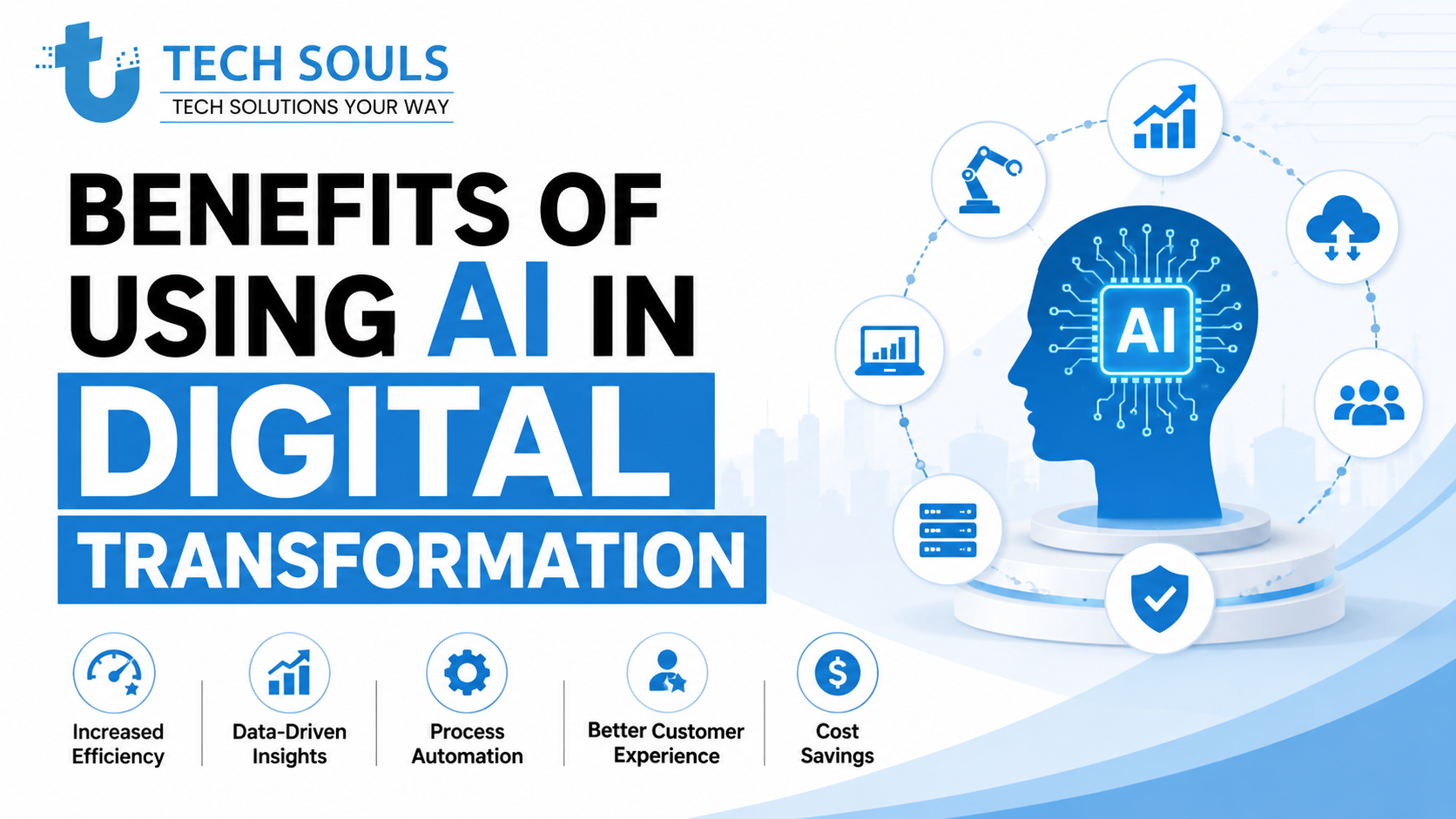
Implementing AI successfully can deliver measurable improvements across nearly every department.
1. Increased Productivity
Employees often lose significant time on repetitive administrative work.
AI automates routine tasks, allowing teams to focus on strategic initiatives, customer service, and innovation.
Examples
Instead of manually:
- entering customer data,
- sorting emails,
- preparing spreadsheets,
employees can focus on solving customer problems and growing the business.
2. Faster Decision-Making
Business leaders frequently wait days—or even weeks—for reports.
AI platforms analyze information in real time.
This allows managers to respond faster to changing conditions.
Example:
Instead of reviewing monthly sales reports, executives receive daily insights with recommendations.
3. Reduced Operating Costs
Automation reduces:
- manual labor
- repetitive processing
- unnecessary approvals
- operational delays
- human error
Over time, these efficiencies can significantly lower operational expenses.
4. Better Customer Experience
AI helps organizations provide:
- faster responses
- personalized recommendations
- intelligent chat support
- improved service quality
- consistent communication
Satisfied customers are more likely to become repeat customers.
5. Higher Accuracy
Manual processes naturally introduce mistakes.
Examples include:
- incorrect invoices
- duplicate records
- missed approvals
- inconsistent reporting
AI reduces these errors through standardized workflows and automated validation.
6. Greater Scalability
As organizations grow, manual processes become difficult to manage.
AI allows businesses to expand operations without increasing administrative workloads at the same rate.
Growth becomes more sustainable.
Industry Use Cases
Healthcare
Healthcare organizations can automate:
- appointment scheduling
- patient communication
- administrative documentation
- medical record organization
This allows healthcare professionals to spend more time caring for patients.
Retail
Retail businesses benefit through:
- demand forecasting
- inventory optimization
- customer segmentation
- recommendation engines
- dynamic pricing
- personalized marketing
Manufacturing
Manufacturers use AI for:
- predictive maintenance
- production planning
- quality inspection
- supply chain optimization
- equipment monitoring
This minimizes downtime while improving operational efficiency.
Financial Services
Banks and financial institutions commonly apply AI to:
- fraud detection
- risk analysis
- loan assessment
- customer service
- compliance monitoring
AI accelerates decision-making while improving accuracy.
Education
Educational institutions increasingly use AI for:
- personalized learning
- automated grading
- student engagement analytics
- administrative automation
- learning recommendations
Teachers gain more time to focus on instruction instead of repetitive administrative work.
Logistics & Supply Chain
AI helps logistics companies optimize:
- delivery routes
- warehouse operations
- inventory levels
- fleet management
- shipment forecasting
Even small improvements in route planning can reduce transportation costs.
AI Implementation Roadmap
Digital transformation should happen gradually rather than all at once.
Phase 1 — Business Assessment
Identify:
- current bottlenecks
- repetitive tasks
- inefficient workflows
- measurable business goals
Questions to ask:
- Where do employees spend the most time?
- Which tasks produce the most errors?
- What processes slow down growth?
Phase 2 — Data Preparation
AI performs best with reliable data.
Businesses should:
- remove duplicate records
- standardize formats
- improve data quality
- establish governance policies
Poor-quality data leads to poor AI outcomes.
Phase 3 — Pilot Project
Avoid implementing AI everywhere immediately.
Instead:
Choose one department.
Examples:
- HR
- Customer Support
- Finance
- Sales
- Operations
Measure results before expanding.
Phase 4 — Employee Training
Technology alone doesn't create transformation.
Employees must understand:
- how AI works
- how workflows change
- when human oversight is required
- how to use AI responsibly
Organizations that invest in training generally see higher adoption rates.
Phase 5 — Scale Across Departments
Once the pilot succeeds:
Expand AI to:
- finance
- marketing
- operations
- procurement
- customer support
- human resources
Maintain consistent governance throughout the rollout.
Measuring AI Success
Organizations should define measurable Key Performance Indicators (KPIs) before implementation.
| KPI | Why It Matters |
| Time saved | Measures automation efficiency |
| Cost reduction | Demonstrates financial impact |
| Customer satisfaction | Evaluates service improvements |
| Employee productivity | Tracks operational gains |
| Error rate | Measures process accuracy |
| Revenue growth | Indicates business value |
| Process completion time | Assesses workflow optimization |
| Employee adoption | Shows implementation success |
Without measurable KPIs, it becomes difficult to determine whether AI initiatives are delivering value.
Challenges and Limitations
While AI offers substantial benefits, successful implementation also requires addressing several common challenges.
1. Poor Data Quality
AI depends on accurate, complete, and consistent data.
If the underlying data contains errors or outdated information, AI recommendations may be unreliable.
Best Practice: Conduct a data quality audit before deployment.
2. Employee Resistance
Employees may worry that AI will replace their jobs.
In reality, AI is most effective when it augments human work rather than replacing it entirely.
Best Practice: Communicate how AI supports employees and provide adequate training.
3. Integration Complexity
Connecting AI with existing systems such as CRM, ERP, and accounting software can be technically challenging.
Best Practice: Start with a limited pilot and expand gradually after successful integration.
4. Privacy and Security
Organizations handling customer or financial data must prioritize:
- encryption
- access controls
- compliance
- secure data storage
Failure to address these issues can create legal and reputational risks.
5. Unrealistic Expectations
AI is not a magic solution.
It cannot compensate for:
- poor business processes
- weak leadership
- inaccurate data
- unclear objectives
Successful digital transformation requires technology, strategy, and organizational change working together.
Common Mistakes to Avoid
- ❌ Implementing AI without clear business goals
- ❌ Automating inefficient processes instead of improving them first
- ❌ Ignoring data quality
- ❌ Failing to train employees
- ❌ Expecting immediate ROI
- ❌ Measuring success using only cost savings
- ❌ Choosing tools based solely on popularity
- ❌ Neglecting cybersecurity and governance
Pros and Cons of AI in Digital Transformation
| Pros | Cons |
| Automates repetitive tasks | Requires quality data |
| Improves productivity | Initial implementation costs |
| Supports better decisions | Integration can be complex |
| Reduces manual errors | Employee training is essential |
| Enhances customer experiences | Governance and security are ongoing responsibilities |
| Scales with business growth | Benefits may take time to realize |
Expert Tip
Before selecting any AI platform—including Droven.io—request a demonstration or proof of concept, evaluate integration capabilities with your existing systems, and define success metrics upfront. Choosing a solution that aligns with your business objectives will deliver far greater value than selecting the platform with the longest feature list.
Frequently Asked Questions (FAQs)
What is Droven.io AI in digital transformation?
Droven.io AI is presented as an AI-focused platform intended to help organizations modernize business operations through automation, workflow optimization, and data-driven decision-making. Since publicly available technical documentation may be limited, businesses should verify platform capabilities, integrations, pricing, and security features directly from official sources before adoption.
How does AI support digital transformation?
Artificial intelligence accelerates digital transformation by automating repetitive tasks, analyzing business data, predicting trends, improving customer experiences, and helping organizations make faster, more informed decisions.
Can small businesses benefit from AI?
Yes. AI is no longer limited to large enterprises.
Small businesses commonly use AI for:
- Customer support chatbots
- Email automation
- Marketing personalization
- Inventory management
- Appointment scheduling
- Sales forecasting
- Document automation
Starting with one high-impact workflow is often the most cost-effective approach.
Does AI replace employees?
Not entirely.
In most organizations, AI augments human work rather than replacing it. It handles repetitive and data-intensive tasks, allowing employees to focus on creativity, strategic planning, customer relationships, and problem-solving.
Businesses that combine AI with skilled employees usually achieve better long-term outcomes than those relying on automation alone.
Which industries benefit the most from AI-powered digital transformation?
Almost every industry can benefit, including:
- Healthcare
- Retail
- Manufacturing
- Finance
- Education
- Logistics
- Insurance
- Real Estate
- E-commerce
- Customer Service
- Marketing
- Human Resources
The specific benefits depend on the organization's goals and processes.
Is digital transformation only about AI?
No.
Digital transformation involves improving people, processes, and technology together. AI is one of the most powerful tools within a broader transformation strategy, but it is not the only component.
Successful transformation also requires:
- Leadership support
- Process improvement
- Employee training
- Data governance
- Cybersecurity
- Change management
How long does AI implementation usually take?
Implementation time varies depending on:
- Organization size
- Existing infrastructure
- Data quality
- Integration complexity
- Project scope
A pilot project may take a few weeks, while enterprise-wide AI adoption can take several months or longer.
What should businesses evaluate before choosing an AI platform?
Consider the following:
- Integration with existing systems
- Data security and compliance
- Ease of use
- Scalability
- Vendor support
- Pricing model
- Customization options
- Reporting capabilities
- Proven business outcomes
- Total cost of ownership
Choosing a platform based on business needs—not just feature count—usually leads to better results.
Key Takeaways
- ✔ AI enhances digital transformation by automating workflows and improving decision-making.
- ✔ Platforms like Droven.io should be evaluated based on verified capabilities, integration options, and business fit.
- ✔ Digital transformation is a long-term strategy involving technology, people, and process improvements.
- ✔ High-quality data and employee adoption are critical to successful AI implementation.
- ✔ Measuring success through KPIs such as productivity, cost savings, and customer satisfaction helps demonstrate ROI.
- ✔ Starting with a pilot project reduces risk and provides valuable insights before scaling AI across the organization.
Conclusion
Artificial intelligence has become a key driver of modern digital transformation, helping organizations streamline operations, reduce repetitive work, and make more informed decisions. Platforms such as Droven.io represent the growing demand for AI-powered business solutions, but selecting the right platform requires careful evaluation of features, integrations, security, and alignment with organizational goals.
Rather than viewing AI as a one-time technology purchase, businesses should treat it as part of an ongoing transformation strategy. Starting with clearly defined objectives, maintaining high-quality data, training employees, and measuring outcomes through meaningful KPIs can significantly improve the likelihood of success.
Whether you're exploring Droven.io or comparing other enterprise AI solutions, the most effective approach is to focus on solving real business problems—not simply adopting AI because it's trending. Organizations that combine thoughtful planning with responsible AI adoption are better positioned to improve efficiency, enhance customer experiences, and remain competitive in an increasingly digital marketplace.
Final Thoughts
Technology evolves quickly, but successful digital transformation is ultimately about creating better experiences for employees and customers. AI is most valuable when it supports those goals through practical, measurable improvements.
Continue Exploring TechSouls
Technology is constantly evolving, and staying informed helps you make better decisions whether you're interested in software, AI, cybersecurity, gadgets, or the latest tech trends. At TechSouls, we regularly publish in-depth guides, tutorials, troubleshooting articles, and breaking technology news to keep you updated with accurate and practical information. If you found this article helpful, explore more of our latest content below to expand your knowledge and stay ahead in the fast-changing world of technology.
[Why Was Innerlifthunt Game Postponed? Complete Update (2026)]
[GDTJ45 Builder Software Guide (2026): Features & How It Works]
[Meetshaxs Performance Optimization: Boost Speed in 2026]
[DualMedia Mobile App Guide: Features, Safety & Availability]
[Best Internet Setup for Gamers: Low Ping & Stable Speed]
[Social Media Stuff EmbedTree Features and Setup Guide 2026]
[Evolution of Digital Technology: Trends, AI and Innovation (2026)]
[Information About Foxtpax Software: Complete Guide (2026)]
[Endbugflow Software: Features, Benefits & How It Works]
[Aggr8Tech Digital Technology: Features, Benefits & Uses (2026)]